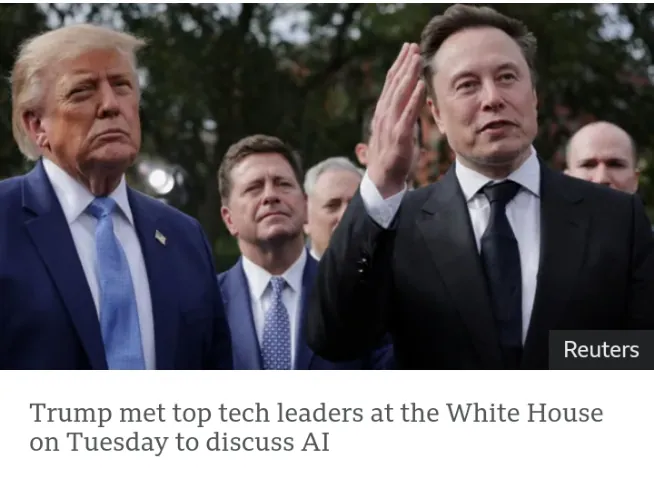
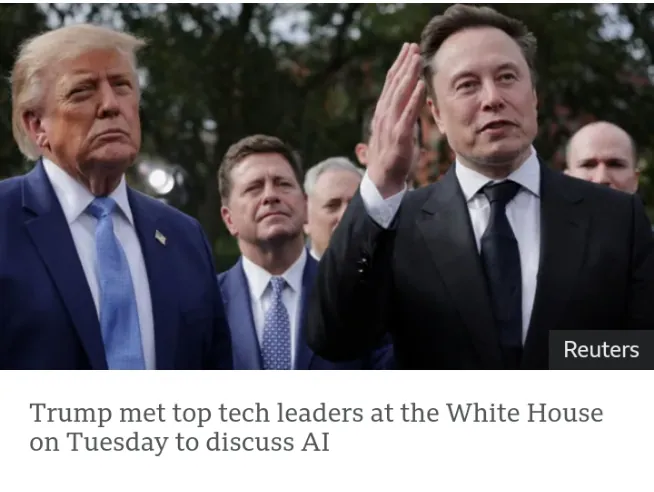
President Donald Trump hosted several major technology and artificial intelligence leaders at the White House on September 29, 2026. The meeting focused on the future of advanced technology, safety, cybersecurity, and the role of private companies in managing powerful systems.
The meeting also produced a new White House Accord on Super Intelligence. Major technology companies agreed to voluntary safety measures, including internal controls, outside audits, and additional oversight.
At the same time, Trump moved forward with his plan to replace the term “Artificial Intelligence” with “Super Intelligence”, or “SI,” in official executive-branch communications.
What Happened at Trump’s White House Tech Meeting?
The White House meeting brought together prominent technology executives and leaders from companies including Google, Meta, OpenAI, Anthropic, Nvidia and xAI. Elon Musk, Mark Zuckerberg, Sundar Pichai, Jensen Huang, Dario Amodei and other technology figures were among those involved in the discussions.
The discussion came as governments, businesses and the public continue to debate how advanced AI systems should be developed and controlled.
However, the agreement announced after the meeting is voluntary rather than a federal law.
Trump described the commitment as morally binding, while the agreement itself allows for the possibility that some of its principles could eventually become part of laws or regulations.
What Is the White House Accord on Super Intelligence?
The Trump Super Intelligence Accord is a voluntary agreement involving major technology and AI companies.
The companies agreed to establish measures designed to improve the safety of increasingly capable AI systems.
According to reports, the agreement includes several layers of oversight.
These include:
- Internal safety controls
- Internal risk reviews
- External auditing
- Board-level oversight
- Monitoring advanced models
- Measures against unintended computer-system access
- Attention to cybersecurity and biological risks
The agreement also encourages participating companies to work together on safety practices and standards.
Importantly, the accord does not create a new federal enforcement system by itself.
Instead, participating companies are making voluntary commitments.
Trump Rebrands Artificial Intelligence as Super Intelligence
Another major part of the meeting was Trump’s terminology change.
The White House published an executive order titled “Inaugurating the Era of Super Intelligence” on September 29, 2026.
The order directs executive-branch agencies, to the extent permitted by law, to use “Super Intelligence” and “SI” instead of “Artificial Intelligence” and “AI” in official correspondence, websites, reports, policy documents and other non-statutory communications.
The order also states that existing documents do not have to be rewritten.
In addition, the administration has been directed to develop proposed legislative language for a federal definition of “Super Intelligence” within 60 days.
Therefore, the change is currently focused on federal government terminology. It does not mean that every company, website, school or private organization in the United States must stop using the term AI.
Why Is Trump Calling AI “Super Intelligence”?
The executive order says the capabilities of modern AI systems have gone beyond what the original term was intended to describe.
The administration argues that advanced systems can amplify human creativity and support work in areas such as science and medicine.
Trump has also previously said that the word “artificial” does not accurately describe the technology.
The terminology change follows comments Trump made at the United Nations General Assembly earlier in September, when he said U.S. documents should use “super intelligence.”
You may also love this latest tech news on how Mark Zuckerberg Loses $9 Billion In A Day As Goldman Sachs Pours Cold Water On Meta Stock Rally
Elon Musk and Other Tech Leaders at the Meeting
Elon Musk was among the prominent technology figures connected to the White House meeting.
Other major names included Meta CEO Mark Zuckerberg, Google CEO Sundar Pichai, Nvidia CEO Jensen Huang and Anthropic CEO Dario Amodei. OpenAI was represented by Greg Brockman.
The presence of executives from several competing technology companies was significant because the agreement involves cooperation around safety standards.
These companies compete heavily in areas such as AI models, computing infrastructure, cloud technology and consumer products.
However, the accord creates a framework for them to cooperate on certain safety practices.
What Does the Accord Mean for AI Safety?
The agreement comes at a time when concerns about advanced AI systems are increasing.
One area of concern is cybersecurity.
For example, the agreement calls for controls designed to prevent AI systems from gaining unintended access to computer systems or helping facilitate cyberattacks. It also addresses potential biological and chemical risks.
External auditing is another important part of the plan.
The participating companies are expected to use outside auditors to examine their systems and safety controls.
However, reports have noted that the accord does not establish a government enforcement mechanism.
That distinction is important because a voluntary industry commitment is different from legislation passed by Congress or legally enforceable federal regulations.
What Could This Mean for Businesses?
The development could affect businesses that build, sell or use advanced AI systems.
For technology companies, stronger internal testing and auditing could become an increasingly important part of product development.
For businesses using AI, the focus on cybersecurity could also encourage more attention to how AI tools access company information and computer systems.
Meanwhile, companies operating in states such as California, Washington, New York, Texas, Colorado, Virginia, Oregon and Massachusetts are likely to remain part of the broader U.S. technology discussion because these states contain major technology, research and business communities.
Need more information on this? Confirm this news from bbc news article
What Could This Mean for Ordinary Americans?
For ordinary Americans, the terminology change may initially be more noticeable than the agreement itself.
Government websites and documents may increasingly use SI and Super Intelligence instead of AI.
However, the technology itself has not suddenly changed simply because the federal government changed its terminology.
The executive order’s definition currently uses the existing statutory definition of artificial intelligence unless a later presidential action or act of Congress changes it.
That means Americans may continue seeing both terms used across the private sector, media, education and technology industries.
Why the Agreement Is Voluntary
One of the most important details about the Trump Super Intelligence Accord is that it is voluntary.
The companies have agreed to follow the outlined principles, but the agreement is not itself a federal statute.
Trump has promoted industry self-regulation as a way to address safety concerns while allowing technological development to continue.
The approach has received different reactions. Some supporters describe the agreement as an important step toward responsible development, while critics have questioned whether voluntary commitments provide enough accountability.
Those disagreements are part of the larger debate over how the United States should govern increasingly powerful AI systems.
Will “AI” Completely Disappear?
No.
The executive order applies to federal executive-branch communications and does not require the entire country to stop using the term “artificial intelligence.”
Private companies, researchers, universities, news organizations and members of the public can continue using AI.
The order also specifically says previously issued regulations, presidential actions, contracts, grants and historical documents do not have to be changed.
Therefore, both AI and Super Intelligence are likely to appear in American technology discussions for some time.
What Happens Next?
The next major step will be the administration’s proposed definition of Super Intelligence.
The executive order gives the Assistant to the President for Science and Technology 60 days to submit proposed legislative language addressing the definition and possible changes to existing federal references to artificial intelligence.
Meanwhile, the participating technology companies are expected to work on the safety commitments contained in the voluntary accord.
The White House has also discussed creating additional oversight around AI safety.
As a result, the September 29 meeting could become an important part of the continuing debate over technology, regulation, cybersecurity and U.S. competitiveness.
Frequently Asked Questions
What is the Trump Super Intelligence Accord?
The Trump Super Intelligence Accord is a voluntary agreement involving major technology and AI companies. It focuses on internal safety controls, external audits and oversight of advanced AI systems.
Which companies signed the Super Intelligence Accord?
Companies represented in the agreement include Google, Meta, OpenAI, Anthropic, Nvidia and xAI.
Did Trump officially rename AI?
Trump issued an executive order directing the federal executive branch to use “Super Intelligence” or “SI” instead of “Artificial Intelligence” or “AI” in applicable official communications.
Does the new name apply to everyone in America?
No. The executive order primarily governs terminology used by the federal executive branch. Private businesses, universities, researchers and individuals can continue using “AI.”
Is the Super Intelligence Accord legally binding?
The accord is voluntary. Trump described it as morally binding, but it does not itself create the same legal obligations as a federal law or regulation.
Why does Trump want to call AI Super Intelligence?
The administration says modern AI systems have capabilities that go beyond the traditional meaning of artificial intelligence and that “Super Intelligence” better reflects those capabilities.
What does SI mean?
SI stands for Super Intelligence, the term the Trump administration is directing federal agencies to use instead of AI in applicable communications.
Will AI regulation change in the United States?
The September 29 accord does not by itself create a new federal regulatory system. However, the administration has indicated that some principles could eventually be incorporated into laws or regulations.
Final Thoughts
Trump’s White House meeting with major technology leaders has brought two developments into the spotlight: a voluntary safety agreement for advanced AI systems and a federal terminology change from Artificial Intelligence to Super Intelligence.
For now, the agreement relies largely on company-level controls, audits and oversight rather than a new federal enforcement structure.
At the same time, the administration’s 60-day timeline for proposing a federal definition of “Super Intelligence” could provide another important development in the months ahead.
For people in the United States, including technology communities in California, Washington, Texas, New York, Colorado and Oregon, the debate could influence how advanced technology is discussed, developed and governed.
Source: White House executive order and reporting from AP, Reuters, CBS News and other outlets.