
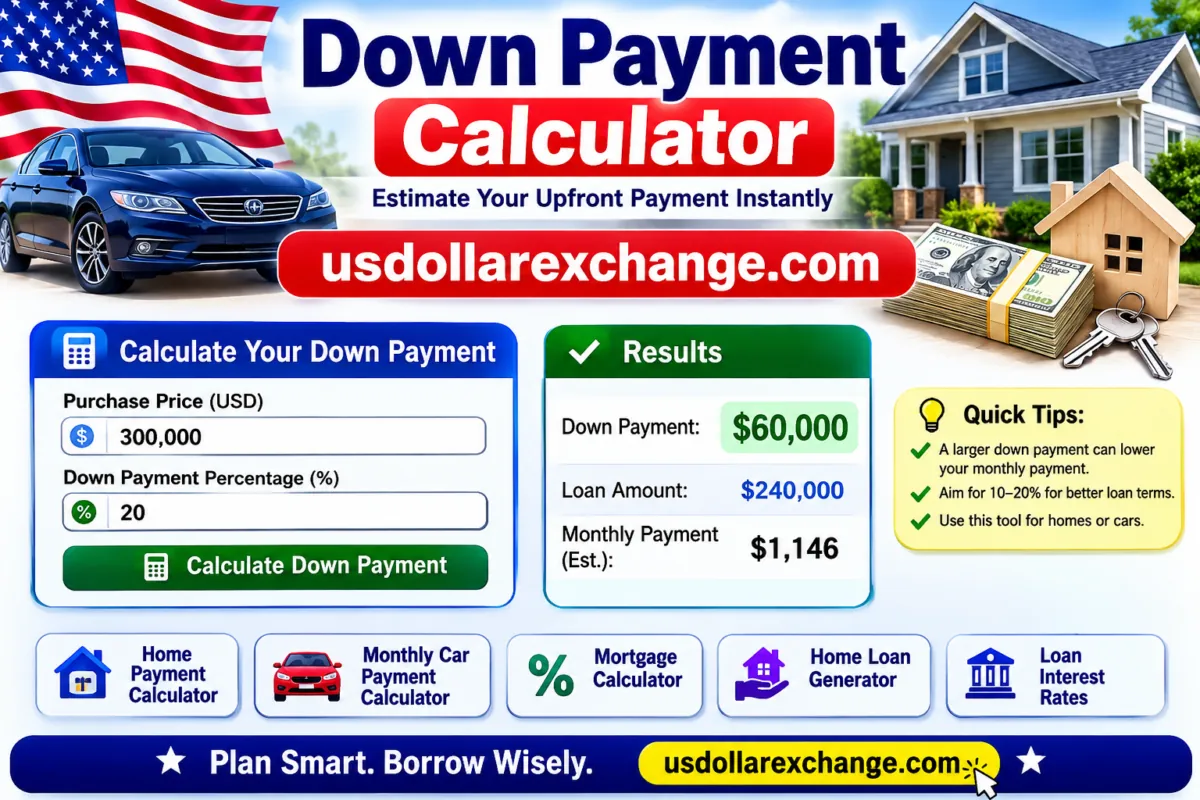
Buying a home in the United States requires careful financial planning. Before making an offer, you need to know how much cash you can contribute upfront and how much you may need to borrow. According to UsDollarExchange, Down Payment Calculator helps you estimate this amount using the purchase price and your preferred down payment percentage.
UsDollarExchange Down Payment Calculator
What is a down payment?
A down payment is the amount of money you pay upfront toward the purchase of a home. It reduces the amount you need to borrow through a mortgage.
Estimate your down payment with UsDollarExchange.
Based on the Home Price and down payment percentage, this is the estimated dollar amount you will need to bring as your Down payment, due at closing.
Disclaimer
This calculator provides an estimate based on the home price and selected down payment percentage. Your actual upfront costs may differ. Closing costs, lender fees, prepaid taxes, insurance, and other expenses may be additional. The estimated remaining amount is not a guaranteed mortgage approval or loan offer. Check with your lender for your exact requirements.
At UsDollarExchange, we believe that financial decisions become easier when the numbers are clear. Whether you are planning to buy a house in Oregon, Texas, Florida, or another state, understanding your down payment can help you prepare a realistic budget.
For example, if you want to purchase a home for $300,000 and plan to put down 10%, your initial contribution would be $30,000. However, the down payment is only part of the money you may need before moving into your new home.
This guide explains how to calculate your down payment, compare different percentages, estimate your mortgage balance, and prepare for additional home-buying expenses.
What Is a Down Payment Calculator?
A Down Payment Calculator is a financial tool that estimates the amount of money you need to contribute toward a property’s purchase price before financing the remaining balance.
UsDollarExchange makes this calculation easy to understand with a simple formula:
Down Payment = Home Price × Down Payment Percentage ÷ 100
Suppose you find a home in Ohio priced at $275,000 and decide to pay 8% upfront.
The calculation would be:
$275,000 × 8 ÷ 100 = $22,000.
Therefore, your down payment would be $22,000. If you finance the remaining purchase price, your estimated starting mortgage balance would be $253,000, excluding any additional financed costs or adjustments.
This calculation gives you a starting point for comparing properties. Nevertheless, UsDollarExchange recommends checking your available savings and other purchase expenses before deciding whether a home fits your budget.
Our MORTGAGE AFFORDABILITY CALCULATOR
Down Payment Examples for Different Home Prices
Your required down payment changes according to the property price and the percentage you choose.
The following figures are mathematical examples, not current housing market prices or mortgage offers.
| Home Price | 3% Down | 5% Down | 10% Down | 20% Down |
|---|---|---|---|---|
| $150,000 | $4,500 | $7,500 | $15,000 | $30,000 |
| $200,000 | $6,000 | $10,000 | $20,000 | $40,000 |
| $250,000 | $7,500 | $12,500 | $25,000 | $50,000 |
| $300,000 | $9,000 | $15,000 | $30,000 | $60,000 |
| $350,000 | $10,500 | $17,500 | $35,000 | $70,000 |
| $400,000 | $12,000 | $20,000 | $40,000 | $80,000 |
| $500,000 | $15,000 | $25,000 | $50,000 | $100,000 |
Consider a $250,000 home. A 5% down payment requires $12,500, while a 20% contribution requires $50,000.
The larger payment reduces the amount you need to finance. However, it also requires more cash upfront. UsDollarExchange encourages buyers to consider how much money they would have left after completing the purchase.
How Much Should You Put Down on a House?
There is no universal down payment percentage that works for every homebuyer. Your decision depends on your savings, income, credit profile, mortgage eligibility, and financial priorities.
Putting Down 3%
Some conventional mortgage programs allow eligible borrowers to make a down payment as low as 3%.
For a $250,000 property, that means paying $7,500 upfront. This option may help buyers who have steady income but have not accumulated substantial savings.
Nevertheless, eligibility requirements apply, and a smaller down payment generally means a larger mortgage balance. UsDollarExchange recommends checking the terms of the specific mortgage program before making a decision.
Putting Down 5%
A 5% down payment on a $300,000 home equals $15,000.
This approach allows you to contribute toward the purchase while keeping more of your savings available for other expenses. However, mortgage insurance and other loan conditions may affect the overall cost.
Compare the monthly payment and fees rather than focusing only on the initial amount.
Putting Down 10%
For a $350,000 property, a 10% down payment is $35,000.
This reduces the amount borrowed compared with a 3% or 5% contribution. Depending on your financial situation, it may provide a reasonable balance between reducing the mortgage and maintaining accessible savings.
UsDollarExchange recommends calculating several options before selecting a target.
Putting Down 20%
A 20% down payment on a $300,000 property is $60,000.
For many conventional mortgages, putting down 20% generally avoids private mortgage insurance (PMI). However, mortgage requirements differ, and some eligible borrowers can purchase a home with considerably less upfront.
A larger down payment may reduce borrowing costs, but it is not automatically the best decision if it leaves you without sufficient emergency savings.
How Your Down Payment Affects Your Mortgage
The amount you contribute upfront determines how much of the purchase price remains to be financed.
Imagine purchasing a $320,000 house.
With a 5% down payment:
- Purchase price: $320,000
- Down payment: $16,000
- Estimated loan amount: $304,000
With a 20% down payment:
- Purchase price: $320,000
- Down payment: $64,000
- Estimated loan amount: $256,000
The difference between the two loan amounts is $48,000.
Consequently, the larger down payment can reduce the principal-and-interest payment and the total interest paid over the loan term, assuming comparable interest rates and repayment periods.
For illustration, suppose both loans have a 30-year term and a hypothetical fixed annual interest rate of 6.5%. The estimated monthly principal-and-interest payment would be approximately $1,921 on the $304,000 loan and $1,618 on the $256,000 loan.
These figures are examples, not current mortgage quotes. They exclude property taxes, homeowners insurance, mortgage insurance, and other housing expenses.
To understand your potential monthly commitment, combine your down payment estimate with a Mortgage Payment Calculator UsDollarExchange recommends using current lender quotes when preparing a real purchasing budget.
Down Payment vs. Closing Costs
One common budgeting mistake is assuming that the down payment covers every expense associated with buying a house.
Closing costs are separate expenses that may include lender fees, appraisal charges, title services, recording fees, and prepaid property taxes or insurance.
For example, imagine purchasing a $300,000 home with a 10% down payment.
Your down payment would be $30,000.
If your closing costs and prepaid expenses were $8,000 in this illustrative example, your combined upfront requirement would be $38,000.
Actual closing costs vary according to the property, lender, location, and transaction. The $8,000 figure is not a standard fee or a prediction of what every buyer will pay.
Additionally, you may need money for moving, immediate repairs, furniture, and utility deposits.
UsDollarExchange recommends requesting a Loan Estimate from your lender and reviewing the expected expenses before committing your savings.
How to Use a Down Payment Calculator Effectively
A calculator provides a useful starting point when you enter realistic figures.
Firstly, enter the purchase price of the property you are considering.
Secondly, choose a down payment percentage based on your savings or the requirements of a mortgage program for which you may qualify.
Thirdly, review the estimated cash contribution. Make sure the amount is available without compromising essential expenses.
After that, subtract the down payment from the purchase price to estimate the amount you may need to borrow.
Subsequently, estimate your monthly mortgage payment using a suitable loan term and an interest rate based on current lender information.
Meanwhile, calculate your expected closing costs and ongoing housing expenses separately.
Finally, compare the results with your income, debt payments, and monthly household budget.
UsDollarExchange encourages buyers to treat calculator results as estimates rather than guaranteed loan approvals or final lending terms.
How to Save for a Down Payment
Saving for a home can take time, particularly when you are paying rent and managing everyday expenses.
Start by setting a specific savings target. Suppose you want to save $24,000 over two years.
You would need to save $1,000 each month for 24 months, excluding any interest earned.
If that target is too high, consider extending your timeline, exploring a less expensive property, or checking whether you qualify for down payment assistance.
In addition, review your regular expenses to identify costs you could reduce without affecting essential needs.
You might also arrange automatic transfers into a dedicated savings account after receiving your income.
However, avoid putting every available dollar into your down payment. An emergency fund can help cover unexpected repairs, medical expenses, or changes in employment.
UsDollarExchange recommends building a savings plan that supports both your home purchase and your financial stability afterward.
How Location Affects Your Home-Buying Budget
The down payment formula remains the same across the United States, but the total cost of homeownership can vary considerably by location.
For example, a buyer considering Portland, Oregon, may face different property prices and housing expenses from someone searching in Dallas, Texas, or Orlando, Florida.
Property taxes, homeowners insurance, local fees, and maintenance costs can affect the amount you need to budget each month.
Therefore, compare the complete cost of owning a specific property instead of relying on the down payment percentage alone.
UsDollarExchange recommends researching local expenses and asking lenders or qualified housing professionals for estimates relevant to your circumstances.
Common Down Payment Mistakes to Avoid
Using all your savings: A large down payment can reduce borrowing, but leaving yourself without emergency funds may create financial pressure.
Assuming 20% is compulsory: Some eligible borrowers qualify for mortgages with smaller down payments. Check the conditions of the available programs.
Ignoring mortgage insurance: Some mortgages require mortgage insurance when the down payment is below a specified threshold.
Forgetting closing costs: The amount needed at closing may exceed the down payment itself.
Choosing a property based only on loan approval: The maximum amount a lender approves may be higher than the amount you can comfortably afford.
Using outdated interest rates: Mortgage rates change, so use a current quote when comparing payment options.
Avoiding these mistakes can help you prepare a more realistic budget and make informed decisions.
Frequently Asked Questions
1. How much is a 20% down payment on a $250,000 house?
A 20% down payment on a $250,000 property is $50,000.
Calculation: $250,000 × 0.20 = $50,000.
The remaining $200,000 would be the estimated mortgage amount if you financed the entire balance.
2. Can I buy a house with a 5% down payment?
Yes, some mortgage programs allow eligible buyers to put down 5%. Requirements vary according to the lender, loan program, property, and borrower’s circumstances.
Compare the interest rate, insurance requirements, and fees before choosing an option.
3. Is a 20% down payment always better?
Not necessarily. A larger down payment reduces your mortgage balance and may eliminate PMI on a conventional mortgage.
However, using too much cash upfront could leave you with insufficient emergency savings.
4. Does a Down Payment Calculator include closing costs?
A basic calculator generally estimates the down payment using the property price and selected percentage.
Closing costs are usually separate unless the calculator specifically includes them.
5. How do I calculate a 10% down payment?
Multiply the purchase price by 0.10.
For example, 10% of a $280,000 property is $28,000.
6. Does my credit score affect my down payment?
Your credit profile can influence mortgage eligibility, interest rates, and the loan options available to you.
However, down payment requirements also depend on the mortgage program and other eligibility conditions.
7. How much should I save before buying a home?
Your savings target should include the down payment, closing costs, moving expenses, and an emergency reserve.
The exact amount depends on your property price, financing arrangements, and personal circumstances.
Start Planning Your Home Purchase
A Down Payment Calculator helps you estimate the money you need upfront, compare different payment percentages, and understand how much you may need to borrow.
Begin with a realistic purchase price, calculate several down payment options, and account for closing costs and ongoing housing expenses.
UsDollarExchange aims to make financial planning more accessible through clear explanations and practical calculations. With the right preparation, you can approach homeownership with a better understanding of your financial commitments.
Before making an offer, compare mortgage options, review your savings, and ensure the expected payment fits your household budget. A well-planned purchase can help you avoid unnecessary financial pressure and make a more confident decision.
