
If you know the remaining loan term
Use this calculator if the term length of the remaining loan is known and there is information on the original loan.
Mortgage Payoff Results
Because of this, many homeowners want to know how they can pay off their mortgage faster.
A Mortgage Payoff Calculator can help.
The calculator shows how your current mortgage payment affects your payoff date.
Additionally, it can show what happens when you make extra payments.
As a result, you can compare different strategies before changing your payment plan.
What Is a Mortgage Payoff Calculator?
A Mortgage Payoff Calculator is a financial tool that estimates how long it may take to pay off your home loan.
First of all, you enter basic information about your mortgage.
This may include your remaining loan balance, interest rate, monthly payment, and remaining loan term.
Next, you can add an extra payment amount.
Then, the calculator estimates your new payoff date and potential interest savings.
For example, suppose you have a $300,000 mortgage and decide to pay an additional $200 each month.
The calculator can help you see how that extra money may reduce your loan term.
In other words, a Mortgage Payoff Calculator helps you understand the financial effect of paying more than your required monthly payment.
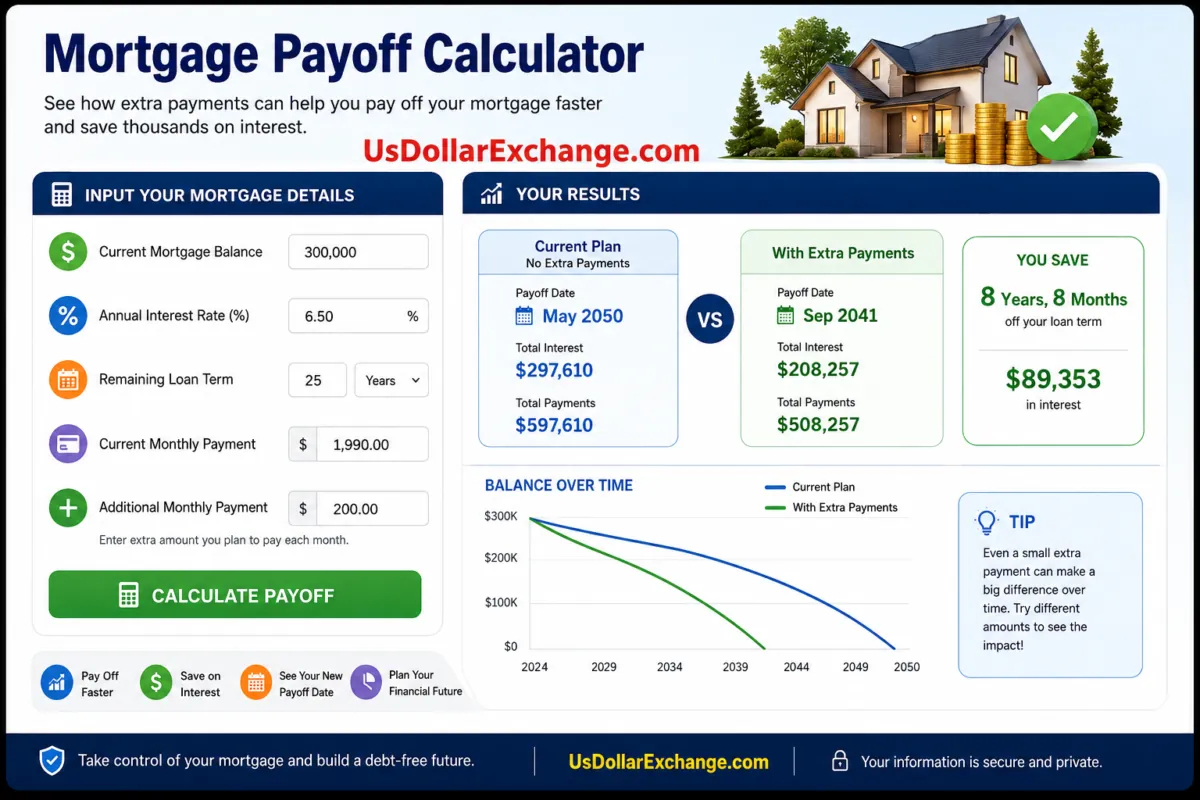
How the Mortgage Payoff Calculator Works
To begin with, enter your current mortgage balance.
This is the amount you still owe on your home.
Next, enter your mortgage interest rate. For instance, if your current rate is 6.5%, enter 6.5%.
After that, enter your current monthly principal and interest payment.
Then, enter the number of years or months remaining on your mortgage.
Finally, enter any additional amount you plan to pay.
The calculator can then estimate:
- Your estimated mortgage payoff date
- Your new monthly payment
- Your remaining interestPotential interest savings
- Time saved on your mortgage
- The effect of additional payments
Therefore, you can use the results to make a more informed mortgage decision.
Mortgage Payoff Calculator Early Payments
Making additional payments early can be an effective way to reduce mortgage interest.
First, understand that mortgage interest is generally calculated based on your outstanding principal balance.
Because of this, reducing the balance earlier can reduce the amount of interest charged over time.
For example, an extra payment made toward principal can reduce the balance faster.
Consequently, future interest may be calculated on a smaller balance.
A Mortgage Payoff Calculator can show the possible difference between making only your required payment and making additional early payments.
You may also check our Down Payment Calculator
Why Early Mortgage Payments Matter
Early extra payments may help you:
- Reduce your principal balance faster
- Pay less interest over the life of the loan
- Shorten your mortgage term
- Build home equity faster
- Reach mortgage freedom sooner
Moreover, even a small recurring extra payment can make a difference over many years.
However, always check your mortgage agreement before making large additional payments.
Some loans may have specific rules about extra payments or prepayment penalties.
Mortgage Calculator With Extra Payments
A Mortgage Calculator With Extra Payments helps you compare your normal mortgage schedule with a faster repayment plan.
For instance, you could compare:
- Your regular monthly payment
- An extra $100 per month
- An extra $250 per month
- An extra $500 per month
- One additional mortgage payment each year
- Occasional lump-sum payments
Additionally, you can test different amounts to find a payment strategy that fits your budget.
Example of Extra Mortgage Payments
Suppose your required mortgage payment is $2,000 per month.
Meanwhile, you decide to pay $2,250 instead.
The additional $250 goes toward reducing the mortgage balance, assuming your lender applies the extra amount to principal.
As a result, you may pay off the loan earlier and potentially save money on interest.
Similarly, a yearly lump-sum payment can reduce your principal.
Therefore, a Mortgage Payoff Calculator is useful when you want to compare several payment strategies before choosing one.
Mortgage Calculator Payment
Your mortgage payment usually includes more than just the amount that reduces your loan balance.
In particular, a monthly mortgage payment may include:
- Principal
- Interest
- Property taxes
- Homeowners insurance
- Mortgage insurance, when applicable
- Other escrow costs
However, when calculating how quickly you can pay off your mortgage, principal and interest are especially important.
For example, paying additional principal can reduce your outstanding balance.
Then, future interest may be calculated using that lower balance.
Because of this, it is important to understand what your monthly mortgage payment includes.
Also check our latest article on MORTGAGE AFFORDABILITY CALCULATOR
How Much Should I Pay Toward My Mortgage?
There is no single extra payment amount that works for every homeowner.
First, review your monthly income and expenses.
Next, consider your emergency savings, other debts, retirement contributions, and financial goals.
Additionally, compare your mortgage interest rate with other opportunities for your money.
For instance, if you have high-interest credit card debt, paying that debt may deserve priority over making extra mortgage payments.
Therefore, the best strategy depends on your complete financial situation.
Mortgage Loan Payoff Calculator
A Mortgage Loan Payoff Calculator helps homeowners estimate when their mortgage could be completely paid off.
Specifically, you can use it to answer questions such as:
- When will I pay off my mortgage?
- How much interest will I pay?
- How much interest can I save?
- What happens if I pay extra every month?
- How much faster can I pay off my home?
- What happens if I make a yearly lump-sum payment?
For example, if you have 25 years remaining on your mortgage, adding extra principal payments may reduce the number of years you need to make payments.
Furthermore, the calculator lets you test different scenarios without changing your actual mortgage.
How to Pay Off My Home Faster
If you are asking, “How to pay off my home faster?”, there are several strategies to consider.
1. Make Extra Monthly Payments
First, consider adding a fixed amount to your monthly mortgage payment.
For example, you could add $100, $250, or $500 each month.
2. Make Biweekly Payments
Instead of making one monthly payment, some homeowners choose a biweekly payment schedule.
Because there are 52 weeks in a year, biweekly payments can result in the equivalent of an additional monthly payment each year.
However, check with your lender before changing your payment schedule.
3. Make Extra Principal Payments
Ask your lender how to make sure additional money is applied to principal.
This is important because simply paying money ahead of the next due date may not always have the same effect as making a principal reduction.
4. Use Unexpected Money
You may choose to put part of a bonus, tax refund, inheritance, or other unexpected income toward your mortgage.
For instance, a $2,000 lump-sum payment can immediately reduce your outstanding balance.
5. Refinance When Appropriate
Refinancing may help in some situations, particularly when mortgage rates and your financial circumstances make it beneficial.
However, refinancing has costs and does not automatically save money.
Therefore, compare the total costs and long-term savings before refinancing.
Benefits of Using a Mortgage Payoff Calculator
A Mortgage Payoff Calculator can make mortgage planning easier.
First, it gives you a clearer picture of your current repayment schedule.
Next, it lets you test different extra payment amounts.
Additionally, it can help you understand the potential relationship between extra payments, interest savings, and your payoff date.
Moreover, it can help you set a realistic mortgage-free goal.
In other words, instead of guessing, you can use estimated numbers to compare your options.
Mortgage Payoff Calculator vs. Regular Mortgage Calculator
A regular mortgage calculator usually focuses on estimating your monthly payment based on the loan amount, interest rate, and loan term.
Meanwhile, a Mortgage Payoff Calculator focuses more specifically on paying off an existing mortgage.
Similarly, both tools can help with mortgage planning.
However, they answer different questions.
A mortgage calculator may answer:
- “What could my monthly payment be?”
- A Mortgage Payoff Calculator may answer:
- “When could I pay off my current mortgage, and what happens if I pay extra?”
Therefore, homeowners who already have a mortgage may find a payoff calculator especially useful.
Tips for Using a Mortgage Payoff Calculator
First of all, use your current mortgage balance instead of the original loan amount.
Next, use your actual interest rate.
Then, check your mortgage statement for your current principal and interest payment.
After that, enter realistic extra payments.
For example, do not choose an extra $1,000 per month if that amount would make your household budget difficult.
Additionally, try several scenarios.
You could compare $100, $250, $500, and $1,000 in extra monthly payments.
Finally, use the results as estimates rather than guarantees.
Your actual mortgage payoff can vary because of lender rules, payment timing, escrow amounts, interest calculations, and other factors.
For more information on this topic, check here ramseysolutions real estate mortgage payoff calculator
Frequently Asked Questions About Mortgage Payoff Calculator
What is a Mortgage Payoff Calculator?
A Mortgage Payoff Calculator estimates how long it may take to repay your mortgage and how extra payments could affect your payoff date and interest costs.
Does paying extra on my mortgage save money?
Generally, paying extra principal can reduce the balance faster.
As a result, you may pay less interest over the remaining life of the loan.
How much extra should I pay on my mortgage?
There is no universal amount. You should choose an amount that fits your income, expenses, savings, and other financial goals.
Is it better to pay extra monthly or make a lump-sum payment?
Both strategies can reduce your mortgage balance.
However, the financial effect depends on your loan terms, payment timing, and how your lender applies additional payments.
Can I pay off a 30-year mortgage early?
Yes. Many homeowners pay off a 30-year mortgage earlier by making additional principal payments.
However, check your mortgage terms for any applicable prepayment rules.
How can I pay off my mortgage in 10 years?
You may need significantly higher payments to repay a 30-year mortgage in 10 years.
Use the Mortgage Payoff Calculator to test the monthly payment required based on your remaining balance and interest rate.
Does paying an extra $100 a month help?
Yes, it can. The exact time and interest savings depend on your remaining mortgage balance, interest rate, and remaining term.
Should I pay off my mortgage or invest the extra money?
That depends on your interest rate, investment goals, risk tolerance, taxes, and overall financial situation.
Therefore, compare both options carefully before making a decision.
Does a Mortgage Payoff Calculator include property taxes and insurance?
Usually, a payoff calculation focuses on the mortgage principal and interest.
Property taxes and homeowners insurance are separate costs and may continue after the mortgage is paid off.
How accurate is a Mortgage Payoff Calculator?
A Mortgage Payoff Calculator provides an estimate based on the information you enter.
Your actual payoff amount may differ because of lender calculations, payment dates, fees, escrow, and other loan terms.
Start Planning Your Mortgage Payoff
Paying off a mortgage is a major financial goal.
However, you do not have to rely on guesswork.
First, enter your current mortgage information into the Mortgage Payoff Calculator.
Next, test different extra payment amounts.
Then, compare your estimated payoff dates and potential interest savings.
For example, you can compare your current payment with an additional $100, $250, or $500 per month.
As a result, you can see which strategy may fit your budget and goals.
Finally, remember that calculator results are estimates.
Always confirm payment instructions and payoff details with your mortgage lender before making major changes.
