Mortgage Payment Calculator Colorado

Buying a home in Colorado is a major financial decision. Therefore, knowing your estimated mortgage payment can help you plan your budget before you apply for a home loan.

Mortgage Payment Calculator Colorado

Estimate your monthly mortgage payment with taxes and insurance.

Estimated Monthly Payment
$0
Principal & Interest $0
Property Tax $0
Home Insurance $0
PMI $0
HOA $0
Loan Amount $0
Total Interest $0

Colorado Mortgage Rates

Mortgage Product Rate Change
30-Year Fixed 6.50% —
15-Year Fixed 5.90% —
5/1 ARM 6.10% —
Mortgage rates are shown for informational purposes. Actual rates vary by lender, borrower, credit profile, loan type and property.

Our Mortgage Payment Calculator Colorado helps you estimate your monthly mortgage payment using important details such as the home price, down payment, interest rate, loan term, property taxes, and homeowners insurance.

Whether you are buying your first home or moving to another property, this calculator can give you a useful starting point.

Home Mortgage Calculator

First of all, a Home Mortgage Calculator can help you understand the cost of buying a home. You can enter the home price, down payment, mortgage rate, and loan term to estimate your payment.

To begin with, consider a $400,000 home in Colorado. If you make a down payment, you will borrow less money. As a result, your monthly principal and interest payment may be lower.

However, your total housing cost can include more than principal and interest.

For example, homeowners may also pay:

  • Property taxes
  • Homeowners insurance
  • Mortgage insurance
  • HOA fees
  • Other homeownership costs

Therefore, using a calculator that considers these costs can provide a more complete estimate.

Colorado Home Buying Costs

Colorado has many different housing markets. For instance, home costs in Denver may differ from costs in Colorado Springs, Aurora, Fort Collins, Boulder, or Grand Junction.

Likewise, property taxes and insurance costs can vary by location and property.

Because of this, your actual mortgage payment may be different from another homeowner’s payment.

Estimate Monthly Mortgage Payment

Next, you can use a Mortgage Payment Calculator Colorado to estimate your monthly mortgage payment before shopping for a home.

Your payment is generally affected by four major factors:

  1. Home purchase price
  2. Down payment
  3. Mortgage interest rate
  4. Loan term

In addition, taxes and insurance can affect your total monthly housing cost.

For example, suppose you purchase a $400,000 home and make a $80,000 down payment. Your estimated loan amount would be $320,000.

Then, the interest rate and loan term would determine much of your principal and interest payment.

A 30-year mortgage usually spreads repayment over a longer period. Therefore, the monthly principal and interest payment may be lower than a shorter-term loan.

However, you may pay more total interest over the life of the loan.

What Affects Your Monthly Mortgage Payment?

Several factors can affect your payment.

Home price: A higher home price generally means a larger loan.

Down payment: A larger down payment can reduce the amount you need to borrow.

Interest rate: A higher mortgage rate can increase your monthly payment.

Loan term: A longer loan term can reduce the monthly payment but may increase total interest.

Property taxes: Taxes can add to your monthly housing cost.

Homeowners insurance: Insurance is another cost to consider.

Mortgage insurance: Depending on the loan and down payment, mortgage insurance may apply.

As a result, it is important to look beyond the advertised mortgage payment.

Online Mortgage Calculator

An Online Mortgage Calculator provides a convenient way to estimate home loan costs before speaking with a lender.

Initially, gather the basic information about the property. Next, enter the home price and your expected down payment.

After that, enter the estimated mortgage interest rate and loan term.

Meanwhile, you can add property taxes and homeowners insurance when those figures are available.

For instance, if you are comparing homes in Denver and Colorado Springs, you can change the home price and other figures to see how your estimated payment changes.

Furthermore, an online calculator can help you compare different down payments.

For example, you could compare a 10%, 20%, and 25% down payment. This can show how changing the amount borrowed affects your estimated payment.

Why Use an Online Mortgage Calculator?

An online calculator can help you:

  • Estimate monthly payments
  • Compare different home prices
  • Compare down payments
  • Understand mortgage interest
  • Estimate taxes and insurance
  • Plan a home-buying budget
  • Compare different loan terms

Therefore, it can be useful before contacting a mortgage lender.

However, remember that a calculator provides an estimate. Your lender will determine the actual loan terms, fees, taxes, insurance, and payment.

For more information on this, check smartasset mortgage colorado mortgage calculator

Mortgage Calculator

A Mortgage Calculator can help both new and experienced homebuyers understand potential mortgage costs.

Specifically, you can use it when researching properties in Colorado or other states in the United States.

Similarly, you can adjust the numbers to see how different financial decisions may affect your payment.

You can check our MORTGAGE Calculator

Mortgage Payment Example

Consider this simple example:

Mortgage DetailExample
Home Price$400,000
Down Payment$80,000
Estimated Loan$320,000
Loan Term30 years
Interest Rate6.5%
TaxesAdded separately
InsuranceAdded separately

These numbers are only an example. Your actual payment will depend on your loan terms and property costs.

In other words, do not use an example payment as a guaranteed mortgage quote.

Compare Different Mortgage Options

You can also use a mortgage calculator to compare scenarios.

For example, you could change the home price while keeping the interest rate the same.

Likewise, you could increase the down payment and see how the estimated payment changes.

Then, you could compare a 15-year mortgage with a 30-year mortgage.

As a result, you may have a clearer picture of the long-term cost of each option.
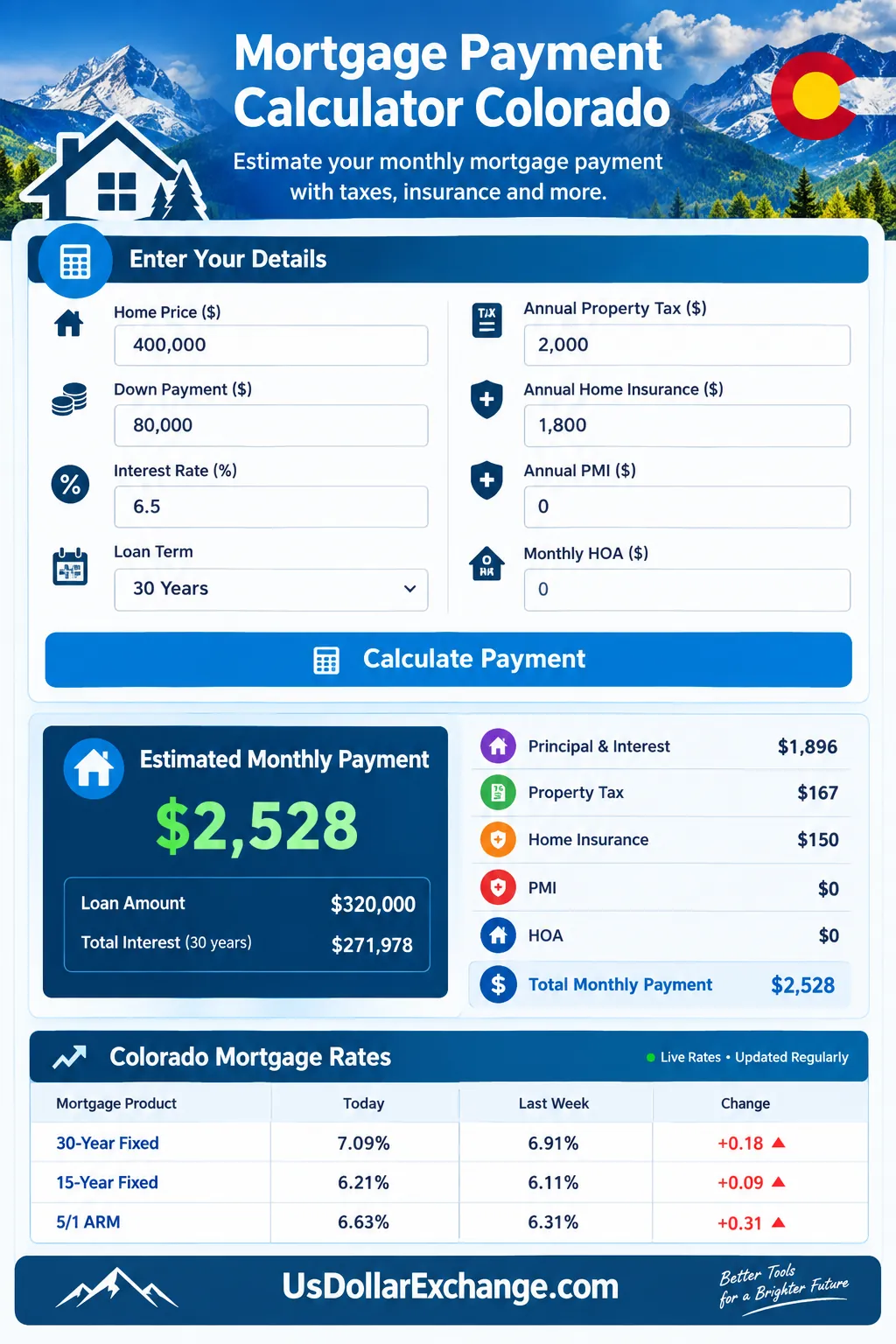
Colorado mortgage payment calculator showing $2,528 estimated monthly payment.

Mortgage Calculator with Taxes and Insurance

A Mortgage Calculator with Taxes and Insurance can provide a more complete estimate of your monthly housing cost.

First, calculate the principal and interest on the mortgage.

Next, add estimated property taxes.

Then, add homeowners insurance.

Additionally, mortgage insurance may need to be included when applicable.

Therefore, the total monthly housing cost can be higher than the principal and interest payment alone.

What Does a Mortgage Payment Include?

A typical monthly mortgage payment can include:

Principal: This is the portion that reduces your loan balance.

Interest: This is the cost charged by the lender for borrowing money.

Property taxes: These are taxes charged by the local government.

Homeowners insurance: This helps provide coverage for your home and property.

Mortgage insurance: This may apply to certain loans or down-payment situations.

In particular, taxes and insurance can vary significantly depending on the property.

Because of this, use actual tax and insurance figures whenever they are available.

Colorado Property Taxes and Mortgage Payments

Colorado homeowners may have property taxes in addition to their mortgage principal and interest.

However, property taxes can vary based on the property and local assessment.

For example, a homeowner in Denver may have different property costs from someone in Colorado Springs or Fort Collins.

Accordingly, entering a realistic estimate can make your calculation more useful.

How to Use the Mortgage Payment Calculator Colorado

To use the Mortgage Payment Calculator Colorado, follow these simple steps.

First, enter the home purchase price.

Next, enter your expected down payment.

Then, enter the mortgage interest rate.

After that, select the mortgage term, such as 15 or 30 years.

Additionally, enter estimated property taxes.

Furthermore, add homeowners insurance.

Finally, review your estimated monthly payment.

For instance, you can repeat the calculation with different home prices or down payments.

As a result, you can compare several home-buying scenarios before making a financial decision.

Who Can Use a Mortgage Payment Calculator Colorado?

A Mortgage Payment Calculator Colorado can be useful for many people.

It may help:

  • First-time homebuyers
  • Existing homeowners
  • People moving to Colorado
  • Investors researching properties
  • Buyers comparing home prices
  • People planning a future purchase
  • Homeowners considering refinancing

Moreover, you do not have to live in Colorado to use the calculator. Anyone researching Colorado properties can use it to estimate potential mortgage costs.

Mortgage Calculator for Colorado Cities

Colorado has different housing markets across the state. Therefore, mortgage calculations can vary depending on the property.

You may use a mortgage calculator when researching homes in:

  • Denver
  • Colorado Springs
  • Aurora
  • Fort Collins
  • Lakewood
  • Thornton
  • Arvada
  • Westminster
  • Pueblo
  • Boulder
  • Grand Junction

Similarly, buyers in other United States states can use mortgage calculators to estimate their potential housing costs.

Frequently Asked Questions

What is a Mortgage Payment Calculator Colorado?

A Mortgage Payment Calculator Colorado is an online tool that estimates the potential monthly cost of a mortgage for a property in Colorado.

How does a mortgage calculator calculate payments?

A mortgage calculator generally uses the loan amount, interest rate, and loan term to estimate principal and interest. Taxes, insurance, and other costs can also be added.

Does a mortgage calculator include taxes and insurance?

Some calculators allow you to add property taxes and homeowners insurance. This can provide a more complete estimate of your monthly housing cost.

How much down payment do I need for a Colorado home?

The required down payment depends on the mortgage program, lender, property, and borrower qualifications. Therefore, there is no single down payment that applies to every buyer.

Is a 30-year mortgage better than a 15-year mortgage?

A 15-year and 30-year mortgage have different payment and interest characteristics. A 30-year loan may spread payments over a longer period, while a 15-year loan generally pays the balance faster.

Can I use this calculator for Denver?

Yes. You can use a Mortgage Payment Calculator Colorado to estimate payments for a home in Denver. You should enter figures that are relevant to the property you are considering.

Can I use the calculator for other Colorado cities?

Yes. You can use it for homes in Colorado Springs, Aurora, Fort Collins, Boulder, Pueblo, and other Colorado locations.

Does the calculator give an exact mortgage payment?

No. The result is an estimate. Your actual mortgage payment can depend on your lender, interest rate, loan program, property taxes, insurance, mortgage insurance, fees, and other costs.

Why should I calculate my mortgage payment before buying a home?

Calculating your estimated payment can help you understand the potential monthly cost. Therefore, you can compare home prices with your planned budget before moving forward.

Can I use a mortgage calculator for other states?

Yes. Mortgage calculators can also be used to estimate home loan costs in other states across the United States. However, taxes, insurance, home prices, and other costs can vary by location.

Final Thoughts

Buying a home involves more than looking at the advertised price. Therefore, estimating the complete monthly housing cost can help you plan more carefully.

A Mortgage Payment Calculator Colorado can help you compare home prices, down payments, interest rates, loan terms, taxes, and insurance.

Moreover, you can change the numbers to explore different scenarios. For example, you can test a larger down payment or a different home price.

Ultimately, use the calculator as a planning tool. Then, confirm your actual mortgage costs, rates, taxes, insurance, and loan terms with qualified lenders and relevant professionals.
Mortgage Refinance Calculator

Mortgage
refinance
calculator

$
yrs
Months
$
%
Additional fields ⌄
YOU COULD REDUCE YOUR
MONTHLY PAYMENT BY
$363 /month

by refinancing at the Best Rate on
UsDollarExchange.com

New monthly payment $1,965
Yearly savings i $7,848
Lifetime savings i -$18.6K
Break-even i 2.3 years
Upfront cost $9,450
Break-even costs explained ⌄
A mortgage refinance calculator helps you estimate what could happen if you replace your current home loan with a new mortgage.

It can help you compare your current payment, new payment, interest costs, and possible savings.

First of all, refinancing may help you get a lower interest rate.

It may also help you change your loan term or take cash from your home equity.

To begin with, enter basic information about your current mortgage.

Then, add the details of the new loan. After that, the calculator can help you compare the numbers.

Because mortgage rates and closing costs can vary, use the results as an estimate. Your lender will provide the final loan terms.8

How to Use the Mortgage Refinance Calculator

Using a mortgage refinance calculator is simple.

First: Enter your current mortgage balance.

Next: Enter your current interest rate.

Then: Enter the number of years remaining on your mortgage.

After that: Enter the new interest rate.

Meanwhile: Choose the new loan term.

Additionally: Enter estimated closing costs.

Finally: Review the estimated payment, savings, interest, and break-even period.

The more accurate your information is, the more useful the estimate can be.

How Does a Mortgage Refinance Calculator Work?

A mortgage refinance calculator uses information about your existing mortgage and your proposed new mortgage.

Initially, you may enter your current loan balance, interest rate, monthly payment, and remaining loan term.

Next, enter the new interest rate and loan term.

You may also enter estimated refinancing costs.

These costs can include lender fees, appraisal fees, title costs, and other closing costs.

For example, suppose you have a $300,000 mortgage at a 7% interest rate.

You are considering a new mortgage at 6%.

The calculator can show how your estimated payment may change.

As a result, you can see whether refinancing could make financial sense.

1. Refinance Mortgage Calculator

A refinance mortgage calculator is useful when you want to compare your existing home loan with a new mortgage.

First, enter your current mortgage balance.

Then, enter your current interest rate and remaining loan term.

Next, enter the proposed refinance rate and new loan term.

Additionally, add estimated closing costs if you know them.

The calculator can then help you estimate your new monthly principal and interest payment.

Moreover, it can help you estimate your potential monthly savings.

For instance, a homeowner in Texas may have a $350,000 mortgage and want to refinance after mortgage rates fall.

The homeowner can use the calculator before contacting several lenders.

Similarly, a homeowner in Florida, California, New York, or Georgia can use the same process.

However, refinancing costs and taxes may vary by location. Therefore, always check the actual costs in your state.

When Should You Use a Refinance Mortgage Calculator?

You can use a refinance mortgage calculator when:

  • Your current interest rate is high.
  • Market rates have fallen.
  • You want a lower monthly payment.
  • You want to change your loan term.
  • You want to estimate your total interest.
  • You are considering a cash-out refinance.
  • You want to compare different refinance offers.

Furthermore, the calculator can help you prepare before speaking with a mortgage lender.

2. Refinance Calculator Mortgage

A refinance calculator mortgage tool can help you understand the possible financial impact of refinancing your home.

In other words, it gives you a simple way to compare your old mortgage with a new mortgage.

First, enter the current balance. Next, enter the current interest rate.

Then, enter the remaining years on your loan.

After that, enter the new loan amount, interest rate, and repayment term.

The calculator can estimate your new monthly payment.

It can also help you compare your estimated interest costs.

For example, imagine a homeowner in Ohio has 20 years remaining on a mortgage.

The homeowner is considering a new 15-year mortgage.

The monthly payment may not fall. However, the homeowner could potentially pay off the loan sooner and reduce long-term interest.

Therefore, do not look only at the monthly payment.

Also consider the total cost of the new mortgage.

What Information Do You Need?

To get a useful estimate, you may need:

  • Current mortgage balance
  • Current interest rate
  • Remaining loan term
  • New interest rate
  • New loan term
  • Estimated closing costs
  • Cash-out amount, if applicable

Equally, having accurate numbers can make your estimate more useful.

3. Mortgage Refinance Estimator

A mortgage refinance estimator gives you a quick way to estimate the possible results of refinancing.

Specifically, it can help answer questions like:

  • How much could my payment change?How much interest could I save?
  • How long could it take to recover refinancing costs?
  • Would a shorter loan term make sense?
  • Could I take cash out of my home?

To illustrate, assume your current mortgage payment is $2,400 per month.

A new mortgage could reduce the estimated payment to $2,100.

That would create an estimated monthly difference of $300.

However, you also need to consider refinancing costs.

For example, if your refinancing costs are $6,000, it could take about 20 months to recover those costs through $300 in monthly savings.

This is often called the break-even point.

What Is the Refinance Break-Even Point?

The break-even point is the time it may take for your monthly savings to cover your refinancing costs.

The basic calculation is:

Break-Even Months = Refinancing Costs ÷ Monthly Savings

For example:

$6,000 ÷ $300 = 20 months

Therefore, it could take about 20 months to recover $6,000 in costs.

Still, this is only an estimate. Your actual savings may change because of taxes, insurance, fees, loan changes, and other costs.

4. Cash Out Refinance Calculator

A cash out refinance calculator helps homeowners estimate a refinance that includes cash taken from home equity.

With a cash-out refinance, you replace your existing mortgage with a larger mortgage.

Then, you may receive the difference in cash, subject to lender requirements and available equity.

For example, suppose your home is worth $500,000 and your existing mortgage balance is $300,000.

You may have significant home equity.

However, the amount you can borrow depends on factors such as your lender’s requirements, loan-to-value limits, credit profile, income, and other conditions.

A cash out refinance calculator can help you estimate the new mortgage amount and payment.

In addition, it can help you compare the estimated cost of borrowing against your current mortgage.

Why Do Homeowners Consider Cash-Out Refinancing?

Homeowners may consider cash-out refinancing for different reasons, such as:

  • Home improvements
  • Debt consolidation
  • Major expenses
  • Education costs
  • Business expenses
  • Other large financial needs

Nevertheless, cash-out refinancing uses your home as collateral.

Therefore, it is important to understand the risks before making a decision.

You can also check our latest article on Closing Cost Calculator

5. Refinance Cash Out Mortgage Calculator

A refinance cash out mortgage calculator combines mortgage refinancing with a cash-out estimate.

First, enter your home’s estimated value. Next, enter your current mortgage balance.

Then, enter the amount you want to take out.

After that, enter the expected interest rate and loan term.

The calculator can help estimate the potential new mortgage payment.

For instance, a homeowner in Arizona may want to refinance a $280,000 mortgage and take $40,000 in cash.

The new loan could be larger than the existing balance because it includes the cash-out amount and potentially some refinancing costs.

As a result, the new monthly payment and total interest may be higher than with the original loan.

Meanwhile, a homeowner in Illinois, Michigan, or North Carolina may have different property values, taxes, and lending costs.

Because of this, your final refinance offer may differ from the calculator estimate.

Also, you can check our USD to CAD Exchange Rates Today in case you want to buy a Home in Canada

Mortgage Refinance Calculator and Interest Savings

One major reason homeowners refinance is to reduce interest costs.

However, a lower interest rate does not always mean you will save money.

For example, you may refinance from a 30-year mortgage into another 30-year mortgage.

Your monthly payment could decrease, but extending the loan may increase the total time you make payments.

Likewise, refinancing into a shorter term could increase your monthly payment.

Yet, you may pay less interest over the life of the loan.

Therefore, compare both the monthly payment and total interest.

Mortgage Refinance Calculator and Closing Costs

Refinancing usually involves costs.

These may include lender charges, appraisal costs, title services, recording fees, and other expenses.

Additionally, some lenders may offer options that reduce upfront costs.

However, these options may come with a higher interest rate or other costs.

For this reason, compare the complete loan offer instead of focusing only on the advertised rate.

Mortgage Refinance Calculator for Different U.S. States

Mortgage refinancing can work differently across the United States.

For example, homeowners in California may face different property costs than homeowners in Ohio.

Similarly, homeowners in Texas, Florida, New York, Georgia, Arizona, Illinois, and Michigan may have different taxes, insurance costs, property values, and lender fees.

In particular, local property taxes and insurance can affect your total monthly housing cost.

Hence, use the calculator for an initial estimate and ask a qualified mortgage professional for current terms in your state.

Is Refinancing Always a Good Idea?

No. Refinancing is not always the best choice.

For example, if you plan to sell your home soon, you may not have enough time to recover the refinancing costs.

Furthermore, a lower payment may result from extending your loan term rather than getting a major interest-rate benefit.

Therefore, consider your long-term plans.

You should also compare several loan offers before choosing a lender.

Benefits of Using a Mortgage Refinance Calculator

A mortgage refinance calculator can help you:

  1. Estimate a new monthly payment.
  2. Compare interest rates.
  3. Estimate potential monthly savings.
  4. Calculate a possible break-even period.
  5. Compare different loan terms.
  6. Estimate cash-out refinancing options.
  7. Prepare for discussions with lenders.

Moreover, it can help you make a more informed decision before submitting a refinance application.

Frequently Asked Questions On Mortgage Refinance Calculator

What is a mortgage refinance calculator?

A mortgage refinance calculator is an online tool that estimates how your mortgage payment and interest costs could change after refinancing.

How accurate is a mortgage refinance calculator?

The calculator provides an estimate. Your final payment may be different because lenders use specific rates, fees, taxes, insurance, credit information, and loan terms.

How much can I save by refinancing my mortgage?

Your savings depend on your current rate, new rate, loan balance, remaining term, new term, and refinancing costs. Therefore, compare the complete loan costs.

Is refinancing worth it if the interest rate drops by 1%?

It can be, but not always. First, compare your expected monthly savings with your refinancing costs. Then, calculate your break-even period.

What is a cash-out refinance?

A cash-out refinance replaces your existing mortgage with a larger loan. You may receive part of your home equity as cash, subject to lender requirements.

Does a cash-out refinance increase your mortgage payment?

It can. Because the new loan may be larger, your payment and total interest could increase. However, the actual payment depends on the new loan terms.

Can I use a mortgage refinance calculator before contacting a lender?

Yes. In fact, using a calculator first can help you understand your options and prepare questions for lenders.

Does refinancing reset my mortgage term?

It can. For example, refinancing into a new 30-year mortgage may restart a longer repayment period. Therefore, compare the remaining term with the new term.

What is a good refinance break-even period?

There is no single period that works for everyone. Generally, you should consider how long you expect to keep the mortgage and whether your expected savings can cover the refinancing costs.

Can I use this calculator for a mortgage in any U.S. state?

Yes, you can use it for an estimate in states such as California, Florida, Texas, New York, Georgia, Ohio, Arizona, Illinois, Michigan, and North Carolina. However, actual mortgage costs vary by location and lender.

Mortgage Payoff Calculator – See How Fast You Can Pay Off Your Home Now

▼ Modify values and click Calculate to use

If you know the remaining loan term

Use this calculator if the term length of the remaining loan is known and there is information on the original loan.

years
%
years
months
Repayment options:
per month
per year
one time

Mortgage Payoff Results

Estimated Current Balance $0
Monthly Payment $0
Estimated Payoff Time 0 years
Total Interest $0
Interest Saved $0
Time Saved 0 months
UsDollarExchange.com
Buying a home is a major financial goal. However, a mortgage can take 15, 20, or 30 years to repay.

Because of this, many homeowners want to know how they can pay off their mortgage faster.

A Mortgage Payoff Calculator can help.

The calculator shows how your current mortgage payment affects your payoff date.

Additionally, it can show what happens when you make extra payments.

As a result, you can compare different strategies before changing your payment plan.

What Is a Mortgage Payoff Calculator?

A Mortgage Payoff Calculator is a financial tool that estimates how long it may take to pay off your home loan.

First of all, you enter basic information about your mortgage.

This may include your remaining loan balance, interest rate, monthly payment, and remaining loan term.

Next, you can add an extra payment amount.

Then, the calculator estimates your new payoff date and potential interest savings.

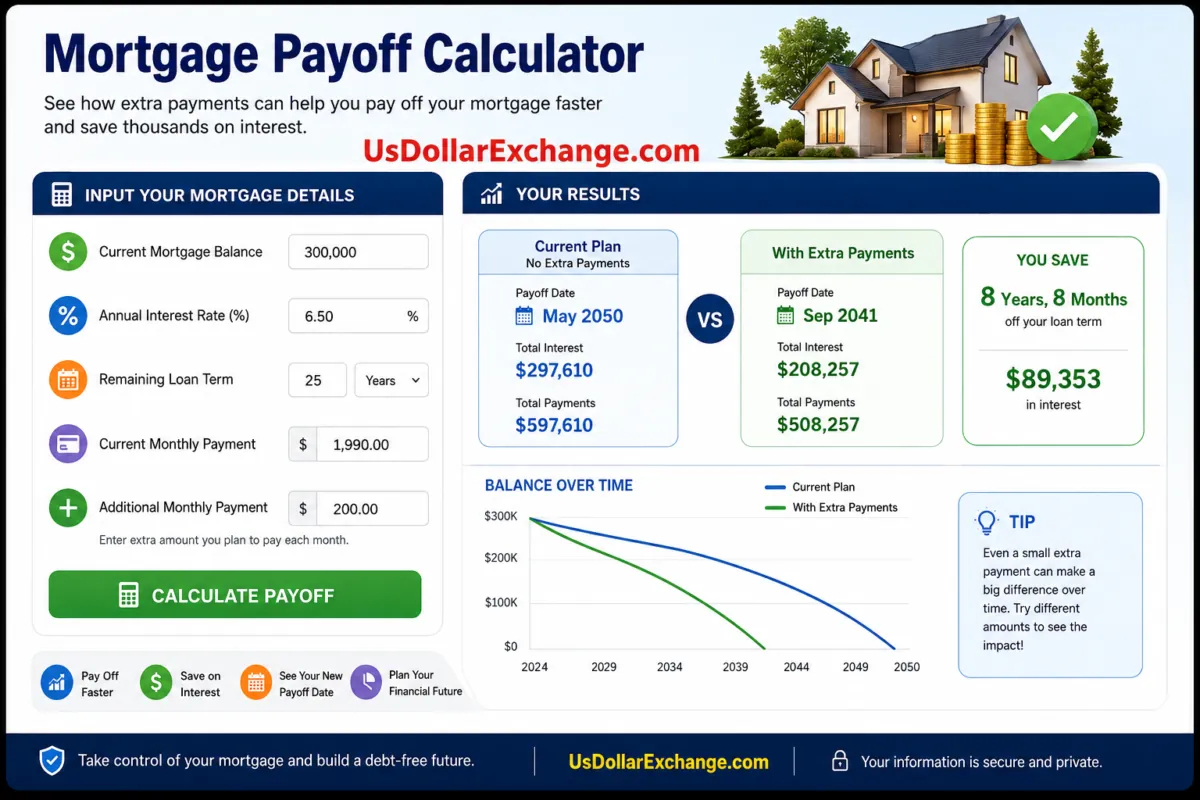
For example, suppose you have a $300,000 mortgage and decide to pay an additional $200 each month.

The calculator can help you see how that extra money may reduce your loan term.

In other words, a Mortgage Payoff Calculator helps you understand the financial effect of paying more than your required monthly payment.

File_00000000b860820ab6307fe07a06babb

How the Mortgage Payoff Calculator Works

To begin with, enter your current mortgage balance.

This is the amount you still owe on your home.

Next, enter your mortgage interest rate. For instance, if your current rate is 6.5%, enter 6.5%.

After that, enter your current monthly principal and interest payment.

Then, enter the number of years or months remaining on your mortgage.

Finally, enter any additional amount you plan to pay.

The calculator can then estimate:

  • Your estimated mortgage payoff date
  • Your new monthly payment
  • Your remaining interestPotential interest savings
  • Time saved on your mortgage
  • The effect of additional payments

Therefore, you can use the results to make a more informed mortgage decision.

Mortgage Payoff Calculator Early Payments

Making additional payments early can be an effective way to reduce mortgage interest.

First, understand that mortgage interest is generally calculated based on your outstanding principal balance.

Because of this, reducing the balance earlier can reduce the amount of interest charged over time.

For example, an extra payment made toward principal can reduce the balance faster.

Consequently, future interest may be calculated on a smaller balance.

A Mortgage Payoff Calculator can show the possible difference between making only your required payment and making additional early payments.

You may also check our Down Payment Calculator

Why Early Mortgage Payments Matter

Early extra payments may help you:

  • Reduce your principal balance faster
  • Pay less interest over the life of the loan
  • Shorten your mortgage term
  • Build home equity faster
  • Reach mortgage freedom sooner

Moreover, even a small recurring extra payment can make a difference over many years.

However, always check your mortgage agreement before making large additional payments.

Some loans may have specific rules about extra payments or prepayment penalties.

Mortgage Calculator With Extra Payments

A Mortgage Calculator With Extra Payments helps you compare your normal mortgage schedule with a faster repayment plan.

For instance, you could compare:

  • Your regular monthly payment
  • An extra $100 per month
  • An extra $250 per month
  • An extra $500 per month
  • One additional mortgage payment each year
  • Occasional lump-sum payments

Additionally, you can test different amounts to find a payment strategy that fits your budget.

Example of Extra Mortgage Payments

Suppose your required mortgage payment is $2,000 per month.

Meanwhile, you decide to pay $2,250 instead.

The additional $250 goes toward reducing the mortgage balance, assuming your lender applies the extra amount to principal.

As a result, you may pay off the loan earlier and potentially save money on interest.

Similarly, a yearly lump-sum payment can reduce your principal.

Therefore, a Mortgage Payoff Calculator is useful when you want to compare several payment strategies before choosing one.

Mortgage Calculator Payment

Your mortgage payment usually includes more than just the amount that reduces your loan balance.

In particular, a monthly mortgage payment may include:

  • Principal
  • Interest
  • Property taxes
  • Homeowners insurance
  • Mortgage insurance, when applicable
  • Other escrow costs

However, when calculating how quickly you can pay off your mortgage, principal and interest are especially important.

For example, paying additional principal can reduce your outstanding balance.

Then, future interest may be calculated using that lower balance.

Because of this, it is important to understand what your monthly mortgage payment includes.

Also check our latest article on MORTGAGE AFFORDABILITY CALCULATOR

How Much Should I Pay Toward My Mortgage?

There is no single extra payment amount that works for every homeowner.

First, review your monthly income and expenses.

Next, consider your emergency savings, other debts, retirement contributions, and financial goals.

Additionally, compare your mortgage interest rate with other opportunities for your money.

For instance, if you have high-interest credit card debt, paying that debt may deserve priority over making extra mortgage payments.

Therefore, the best strategy depends on your complete financial situation.

Mortgage Loan Payoff Calculator

A Mortgage Loan Payoff Calculator helps homeowners estimate when their mortgage could be completely paid off.

Specifically, you can use it to answer questions such as:

  • When will I pay off my mortgage?
  • How much interest will I pay?
  • How much interest can I save?
  • What happens if I pay extra every month?
  • How much faster can I pay off my home?
  • What happens if I make a yearly lump-sum payment?

For example, if you have 25 years remaining on your mortgage, adding extra principal payments may reduce the number of years you need to make payments.

Furthermore, the calculator lets you test different scenarios without changing your actual mortgage.

How to Pay Off My Home Faster

If you are asking, “How to pay off my home faster?”, there are several strategies to consider.

1. Make Extra Monthly Payments

First, consider adding a fixed amount to your monthly mortgage payment.

For example, you could add $100, $250, or $500 each month.

2. Make Biweekly Payments

Instead of making one monthly payment, some homeowners choose a biweekly payment schedule.

Because there are 52 weeks in a year, biweekly payments can result in the equivalent of an additional monthly payment each year.

However, check with your lender before changing your payment schedule.

3. Make Extra Principal Payments

Ask your lender how to make sure additional money is applied to principal.

This is important because simply paying money ahead of the next due date may not always have the same effect as making a principal reduction.

4. Use Unexpected Money

You may choose to put part of a bonus, tax refund, inheritance, or other unexpected income toward your mortgage.

For instance, a $2,000 lump-sum payment can immediately reduce your outstanding balance.

5. Refinance When Appropriate

Refinancing may help in some situations, particularly when mortgage rates and your financial circumstances make it beneficial.

However, refinancing has costs and does not automatically save money.

Therefore, compare the total costs and long-term savings before refinancing.

Benefits of Using a Mortgage Payoff Calculator

A Mortgage Payoff Calculator can make mortgage planning easier.

First, it gives you a clearer picture of your current repayment schedule.

Next, it lets you test different extra payment amounts.

Additionally, it can help you understand the potential relationship between extra payments, interest savings, and your payoff date.

Moreover, it can help you set a realistic mortgage-free goal.

In other words, instead of guessing, you can use estimated numbers to compare your options.

Mortgage Payoff Calculator vs. Regular Mortgage Calculator

A regular mortgage calculator usually focuses on estimating your monthly payment based on the loan amount, interest rate, and loan term.

Meanwhile, a Mortgage Payoff Calculator focuses more specifically on paying off an existing mortgage.

Similarly, both tools can help with mortgage planning.

However, they answer different questions.

A mortgage calculator may answer:

  • “What could my monthly payment be?”
  • A Mortgage Payoff Calculator may answer:
  • “When could I pay off my current mortgage, and what happens if I pay extra?”

Therefore, homeowners who already have a mortgage may find a payoff calculator especially useful.

Tips for Using a Mortgage Payoff Calculator

First of all, use your current mortgage balance instead of the original loan amount.

Next, use your actual interest rate.

Then, check your mortgage statement for your current principal and interest payment.

After that, enter realistic extra payments.

For example, do not choose an extra $1,000 per month if that amount would make your household budget difficult.

Additionally, try several scenarios.

You could compare $100, $250, $500, and $1,000 in extra monthly payments.

Finally, use the results as estimates rather than guarantees.

Your actual mortgage payoff can vary because of lender rules, payment timing, escrow amounts, interest calculations, and other factors.

For more information on this topic, check here ramseysolutions real estate mortgage payoff calculator

Frequently Asked Questions About Mortgage Payoff Calculator

What is a Mortgage Payoff Calculator?

A Mortgage Payoff Calculator estimates how long it may take to repay your mortgage and how extra payments could affect your payoff date and interest costs.

Does paying extra on my mortgage save money?

Generally, paying extra principal can reduce the balance faster.

As a result, you may pay less interest over the remaining life of the loan.

How much extra should I pay on my mortgage?

There is no universal amount. You should choose an amount that fits your income, expenses, savings, and other financial goals.

Is it better to pay extra monthly or make a lump-sum payment?

Both strategies can reduce your mortgage balance.

However, the financial effect depends on your loan terms, payment timing, and how your lender applies additional payments.

Can I pay off a 30-year mortgage early?

Yes. Many homeowners pay off a 30-year mortgage earlier by making additional principal payments.

However, check your mortgage terms for any applicable prepayment rules.

How can I pay off my mortgage in 10 years?

You may need significantly higher payments to repay a 30-year mortgage in 10 years.

Use the Mortgage Payoff Calculator to test the monthly payment required based on your remaining balance and interest rate.

Does paying an extra $100 a month help?

Yes, it can. The exact time and interest savings depend on your remaining mortgage balance, interest rate, and remaining term.

Should I pay off my mortgage or invest the extra money?

That depends on your interest rate, investment goals, risk tolerance, taxes, and overall financial situation.

Therefore, compare both options carefully before making a decision.

Does a Mortgage Payoff Calculator include property taxes and insurance?

Usually, a payoff calculation focuses on the mortgage principal and interest.

Property taxes and homeowners insurance are separate costs and may continue after the mortgage is paid off.

How accurate is a Mortgage Payoff Calculator?

A Mortgage Payoff Calculator provides an estimate based on the information you enter.

Your actual payoff amount may differ because of lender calculations, payment dates, fees, escrow, and other loan terms.

Start Planning Your Mortgage Payoff

Paying off a mortgage is a major financial goal.

However, you do not have to rely on guesswork.

First, enter your current mortgage information into the Mortgage Payoff Calculator.

Next, test different extra payment amounts.

Then, compare your estimated payoff dates and potential interest savings.

For example, you can compare your current payment with an additional $100, $250, or $500 per month.

As a result, you can see which strategy may fit your budget and goals.

Finally, remember that calculator results are estimates.

Always confirm payment instructions and payoff details with your mortgage lender before making major changes.

Mortgage Affordability Calculator With A Complete Guide

Mortgage Affordability Calculator
Modify the values below and click Calculate to estimate how much house you can afford.
before tax
years
%
car/student loan, etc.
%
% per year
% per year
% per year

Estimated Mortgage Affordability

You may be able to afford a home up to:
$0
Estimated monthly housing payment $0
Principal & interest $0
Property tax $0
Homeowners insurance $0
HOA / co-op fee $0
Maximum housing budget $0
This mortgage affordability calculator provides an estimate only. Actual mortgage approval may vary by lender, credit profile, income, debt, loan program, property taxes, insurance and other factors.
Buying a home is a big financial decision. Before you start viewing houses, it helps to know how much you can realistically afford.

A mortgage affordability calculator can give you a quick estimate based on your income, debts, down payment, interest rate, and other costs.

First of all, knowing your budget can help you avoid looking at homes that are too expensive.

To begin with, enter your basic financial information into the calculator.

Then, review the estimated home price, monthly mortgage payment, and other housing costs.

How to Use a Mortgage Affordability Calculator


First, enter your gross annual or monthly income.


Next, enter your monthly debt payments.

These may include car loans, student loans, credit card payments, and other recurring debts.


After that, enter your expected down payment.


Then, add an estimated mortgage interest rate and loan term.


Also, include property taxes, homeowners insurance, HOA fees, and mortgage insurance when applicable.


Finally, review the estimated home price and monthly housing cost.


Because estimates depend on the information you enter, try to use realistic numbers.

Therefore, avoid using an income amount that you may not consistently earn.

What House Can I Afford?

The question “What house can I afford?” is one of the first questions many home buyers ask.

A mortgage affordability calculator can help you find an estimated price range before you apply for a mortgage.

Initially, consider your gross monthly income.

Next, add your monthly debt payments, expected down payment, estimated interest rate, property taxes, homeowners insurance, and other housing costs.

For example, if you earn $7,000 per month but already have large debt payments, your affordable home price may be lower than someone earning the same amount with less debt.

Moreover, lenders look at your debt-to-income ratio (DTI).

Specifically, they compare your monthly debt obligations with your gross monthly income.

Therefore, reducing existing debt may increase the amount you can potentially afford.

However, affordability is not only about what a lender may approve.

You should also consider your personal budget, savings, emergency fund, utilities, maintenance, and other everyday expenses.

File_0000000008a881f49fc125a4615c9d2f

What Affects How Much House You Can Afford?

Several factors can affect your estimated home-buying budget, such as:

  1. Gross monthly income
  2. Monthly debt payments
  3. Down payment
  4. Mortgage interest rate
  5. Loan term
  6. Property taxes
  7. Homeowners insurance
  8. HOA fees
  9. Closing costs
  10. Credit profile
  11. Debt-to-income ratio

As a result, two people with similar incomes may have very different home-buying budgets.

Home Mortgage Calculator

A home mortgage calculator helps you estimate the cost of borrowing money to buy a home.

In addition, it can show how your loan amount, interest rate, and loan term may affect your monthly payment.

For instance, a $300,000 mortgage with a 30-year term will have a different monthly payment from a $300,000 mortgage with a 15-year term.

Next, enter the estimated home price and your down payment.

Then, enter the mortgage interest rate and loan term.

After that, review the estimated monthly payment.

Furthermore, remember that your total monthly housing cost can include more than principal and interest.

It may also include property taxes, homeowners insurance, mortgage insurance, and HOA fees.

In other words, the mortgage payment shown by a basic calculator may not represent your complete monthly housing cost.

Mortgage Affordability vs. Mortgage Payment

A mortgage payment calculator focuses mainly on the cost of a particular loan.

Meanwhile, a mortgage affordability calculator focuses on how much home may fit within your overall finances.

Likewise, both calculators can be useful when planning to buy a home. Specifically, use affordability calculations to set your budget.

Then, use mortgage payment calculations to compare different home prices and loan options.

Mortgage Pre Approval Calculator

A mortgage pre approval calculator can help you estimate how much a lender might consider before you formally apply for pre-approval.

First, enter your income and monthly debt payments. Next, include your estimated down payment and other relevant financial information.

The calculator can then provide an estimated loan amount or home price.

However, a calculator is not the same as official mortgage pre-approval.

A lender may review your income, employment, credit history, assets, debts, and other financial documents.

Therefore, the final amount you qualify for can be different from the calculator’s estimate.

Additionally, mortgage lenders may use different underwriting requirements.

Because of this, you should treat calculator results as estimates rather than guarantees.

How Much Mortgage Can I Be Approved For?

If you are asking “How much mortgage can I be approved for?”, your income and debts are important starting points.

Generally, lenders consider your debt-to-income ratio, credit history, income, assets, down payment, and the loan program you choose.

For example, someone with a strong income and low monthly debt may qualify for a larger mortgage than someone with the same income but significant existing debt.

Similarly, your down payment can affect the amount you need to borrow.

A larger down payment may reduce your mortgage balance and could also reduce certain mortgage costs.

Moreover, interest rates matter. A higher interest rate can increase your monthly payment.

Consequently, the amount you can comfortably afford may decrease.

You can also check our MORTGAGE CALCULATOR

What Is Debt-to-Income Ratio?

Debt-to-income ratio, or DTI, compares your monthly debt payments with your gross monthly income.

For example:

DTI = Total Monthly Debt Payments ÷ Gross Monthly Income × 100

If your monthly debt payments are $2,000 and your gross monthly income is $6,000, your DTI is about 33.3%.

Thus, understanding your DTI can help you prepare for the mortgage application process.

Housing Affordability Calculator

A housing affordability calculator is another useful tool for estimating how much home you may be able to afford.

Specifically, it considers factors that can affect your housing budget.

These may include income, debts, down payment, interest rate, taxes, insurance, and other housing expenses.

In addition, a mortgage affordability calculator can help you compare different scenarios.

For example, you could compare:

  • A $250,000 home with a larger down payment
  • A $300,000 home with a smaller down payment
  • A 15-year mortgage
  • A 30-year mortgage
  • A higher or lower interest rate

Then, you can see how each option may change your estimated monthly payment and overall affordability.

How Much Should I Spend on a House?

There is no single home price that works for everyone.

Your ideal budget depends on your income, debts, savings, lifestyle, and financial goals.

For instance, you may qualify for a larger mortgage but still choose a less expensive home.

This can leave more money available for savings, investments, travel, emergencies, and everyday expenses.

Besides, homeownership comes with costs beyond the mortgage.

Such costs can include repairs, maintenance, utilities, insurance, taxes, and possible HOA fees.

Accordingly, a comfortable budget may be lower than the maximum amount a lender is willing to approve.

Mortgage Affordability Calculator FAQs

What is a mortgage affordability calculator?

A mortgage affordability calculator estimates how much home you may be able to afford based on income, debts, down payment, interest rate, and other housing costs.

How accurate is a mortgage affordability calculator?

A mortgage affordability calculator provides an estimate, not a guaranteed loan amount.

Lenders may consider additional information before approving a mortgage.

What house can I afford with my income?

The answer depends on your income, debts, down payment, interest rate, taxes, insurance, and other costs.

Therefore, use a mortgage affordability calculator to estimate a realistic price range.

How much mortgage can I be approved for?

Your approval amount depends on factors such as income, debt, credit history, assets, down payment, interest rate, and lender requirements.

Is a mortgage affordability calculator the same as a home mortgage calculator?

Not exactly. A home mortgage calculator mainly estimates mortgage payments.

In contrast, a mortgage affordability calculator estimates how much home you may be able to afford.

What is a mortgage pre approval calculator?

A mortgage pre approval calculator estimates a possible loan amount based on information such as income, debts, and down payment.

However, only a lender can provide official pre-approval.

Does my down payment affect home affordability?

Yes. A larger down payment can reduce the amount you need to borrow. It may also affect mortgage insurance and other loan costs.

Should I buy the most expensive house I qualify for?

Not necessarily. A lender’s maximum approval is not always the same as a comfortable personal budget.

Therefore, consider your complete monthly expenses and financial goals.

Can interest rates change how much house I can afford?

Yes. Higher mortgage rates generally increase monthly payments. Consequently, your affordable home price may decrease when interest rates rise.

What costs should I include when calculating housing affordability?

Consider principal, interest, property taxes, homeowners insurance, mortgage insurance, HOA fees, maintenance, and other regular housing expenses.

Final Thoughts

Buying a home becomes easier when you understand your numbers. First, estimate your income and debts.

Next, consider your down payment and expected mortgage rate.

Then, use a mortgage affordability calculator to estimate a realistic home price.

In addition, compare different loan terms and home prices.

Finally, remember that the best home budget is one that fits comfortably within your overall financial plan.

A calculator can help you plan. However, it does not replace professional financial or mortgage advice.

Use your results as a starting point, and speak with a qualified mortgage professional before making a final decision.

Mortgage Calculator And A Complete Guide

Mortgage Calculator

▼ Modify values and click Calculate to use
years
%
Annual Tax & Cost
+ More Options

Your Estimated Monthly Payment

$0.00 per month
Principal & Interest $0.00
Property Taxes $0.00
Home Insurance $0.00
PMI Insurance $0.00
HOA Fee $0.00
Other Costs $0.00
Loan Amount $0.00
Total Interest $0.00
Total Loan Cost $0.00

This mortgage calculator provides an estimate for informational purposes only. Actual mortgage payments may vary based on your lender, loan terms, taxes, insurance, fees, and other costs.

How to Use A Mortgage Calculator

Our Mortgage Calculator helps you estimate your monthly home payment, including principal, interest, property taxes, insurance, PMI, HOA fees, and other annual costs.

1. Enter the Home Price

Enter the purchase price of the home you are considering.

Example: If the home costs $400,000, enter 400000 in the Home Price field.

2. Enter Your Down Payment

Enter your down payment and select either % or $.

For example, if you plan to make a 20% down payment on a $400,000 home, enter 20 and select %.

The calculator will automatically calculate your down payment and loan amount.

3. Enter the Loan Term

Enter the number of years you expect to take to repay the mortgage.

For example, enter 30 for a 30-year mortgage or 15 for a 15-year mortgage.

4. Enter the Interest Rate

Enter your estimated annual mortgage interest rate.

For example, if your estimated rate is 6.614%, enter 6.614.

5. Select the Start Date

Choose the month and year when you expect your mortgage payments to begin.

6. Add Taxes and Other Costs

Keep “Include Taxes & Costs Below” checked if you want a more complete estimate.

Then enter your estimated annual costs:-

  • Property Taxes: Enter the annual property tax rate, such as 1.2%.
  • – Home Insurance: Enter your annual homeowners insurance cost.
  • – PMI Insurance: Enter your annual PMI cost, if applicable.
  • – HOA Fee: Enter your annual HOA fees, if applicable.
  • – Other Costs: Enter other annual homeownership costs you want to include.

7. Click Calculate

After entering your information, click the Calculate button.

The calculator will estimate your:

  • – Monthly mortgage payment-
  • Principal and interest-
  • Monthly property taxes-
  • Monthly homeowners insurance-
  • Monthly PMI-
  • Monthly HOA fees-
  • Monthly other costs-
  • Total loan amount-
  • Total interest-
  • Total loan cost

Example: $400,000 Home

Suppose you are buying a $400,000 home with a 20% down payment, a 30-year mortgage, and a 6.614% interest rate.

First, the 20% down payment would be $80,000, leaving an estimated mortgage balance of $320,000.

Next, you can add your estimated property taxes and annual homeowners insurance.

After that, click Calculate to see your estimated monthly housing cost.

Important Note

The Mortgage Calculator provides an estimate for planning purposes.

Your actual mortgage payment may be different because lenders, property taxes, insurance companies, loan programs, and other costs vary.

For the most accurate estimate, use current information from your lender, local tax authority, and homeowners insurance provider.

Introduction

Buying a home is a major financial decision. Therefore, knowing what you may pay each month can help you plan with confidence.

A Mortgage Calculator gives you a quick way to estimate your monthly home payment before you apply for a home loan.

First of all, a mortgage payment is usually more than the principal and interest on your loan.

Depending on the property and location, your payment may also include property taxes, homeowners insurance, mortgage insurance, and other costs.

To begin with, enter the home price, down payment, interest rate, and loan term into the Mortgage Calculator.

Next, add estimated property taxes and insurance if those options are available. Then, review the estimated monthly payment.

Mortgage calculator with UsDollarExchange.com logo, home price, interest rate, loan term, taxes & insurance icons.

How to Use the Mortgage Calculator

Initially, gather the basic information about the home you want to buy. You will usually need the following:

  • Home purchase price
  • Down payment
  • Mortgage interest rate
  • Loan term
  • Property taxes
  • Homeowners insurance
  • Private mortgage insurance, if applicable
  • HOA fees, if applicable

After that, enter the information into the Mortgage Calculator.

The calculator estimates your monthly principal and interest payment.

In addition, it can help you understand how taxes and insurance may affect your total housing cost.

For example, if you are considering a $300,000 home with a 20% down payment, your loan amount would be approximately $240,000.

The actual payment would depend on your interest rate, loan term, taxes, insurance, and other costs.

Moreover, your actual mortgage payment may differ from the calculator’s estimate.

Lenders use your specific loan terms, credit profile, property details, and other information to determine the final payment.

1. Home Payment Calculator

A home payment calculator helps you estimate how much you may spend on your home each month.

It is useful when you are comparing properties and deciding what price range fits your budget.

First, enter the expected purchase price. Next, enter your down payment and estimated interest rate.

Then, select the mortgage term, such as 15 or 30 years.The result can show your estimated principal and interest payment.

Additionally, you can include property taxes and homeowners insurance to get a more complete estimate.

For instance, someone shopping for a home in Texas may have different property-tax costs from someone buying a similar-priced home in California.

Likewise, a homeowner in Florida may have different homeowners insurance costs than a homeowner in Ohio.

Therefore, a home payment calculator is useful for comparing different locations and home prices.

2. Mortgage Calculator Mortgage Calculator

A mortgage calculator mortgage calculator search usually means a person wants a quick tool to calculate home loan payments.

Although the phrase is repetitive, the search intent is clear: people want to estimate their mortgage costs before making a decision.

A Mortgage Calculator can help you estimate the monthly payment for different loan amounts, interest rates, and repayment periods.

Furthermore, changing one number can show how it affects your payment.

For example, increasing your down payment may reduce the amount you need to borrow.

Similarly, choosing a shorter loan term may increase your monthly payment while potentially reducing total interest paid over the life of the loan.

Also, you can compare different interest rates.

Consequently, the calculator can help you understand why even a small difference in mortgage rates may matter over many years.

3. Estimate Monthly Mortgage Payment

If you want to estimate monthly mortgage payment costs, a Mortgage Calculator is a good starting point.

First, determine the approximate price of the home.

Then, subtract your planned down payment to estimate the loan amount.

After that, enter the expected interest rate and mortgage term.

For example, suppose you purchase a $400,000 home and make a $80,000 down payment.

Your estimated loan amount would be $320,000.

However, the monthly payment is not determined by the loan amount alone.

Property taxes, homeowners insurance, mortgage insurance, and HOA fees can also increase your total monthly housing cost.

In other words, a $320,000 mortgage does not necessarily mean that every homeowner will have the same monthly payment.

To illustrate, two buyers could purchase homes for the same price in New York and Arizona, but their total monthly costs could be different because taxes, insurance, and other expenses vary by location.

4. Loan Estimator Home

A loan estimator home tool can help potential buyers understand how much they may borrow and what their estimated payment could be.

First, consider how much money you can comfortably use for a down payment.

Next, estimate the amount you may need to borrow.

Then, use the Mortgage Calculator to compare different loan scenarios.

For instance, you could compare:

  • A 15-year mortgage
  • A 20-year mortgage
  • A 30-year mortgage
  • Different down payments
  • Different interest rates
  • Different home prices

Besides helping with monthly payments, a loan estimator can help you think about the long-term cost of borrowing.

Equally important, do not choose a mortgage simply because the estimated monthly payment looks affordable.

You should also consider closing costs, maintenance, utilities, taxes, insurance, and your other financial responsibilities.

5. Mortgage Estimator With Taxes and Insurance

A mortgage estimator with taxes and insurance provides a more realistic picture of your potential housing expense.

Property taxes can vary significantly between states, counties, and cities.

Likewise, homeowners insurance costs can vary depending on the property, location, coverage, and insurance company.

For example, a home in California may have different insurance and tax costs from a home in Louisiana.

Similarly, a property in New Jersey may have different property-tax costs from one in North Carolina.

Therefore, adding taxes and insurance to your estimate can make your monthly budget more useful.

In addition, some buyers may need private mortgage insurance (PMI), especially when they make a smaller down payment.

Commercially, HOA fees may also apply to some homes and communities.

As a result, the best mortgage estimate should consider as many relevant costs as possible.

What Does a Mortgage Payment Include?

A typical mortgage payment may contain several components.

Principal: This is the amount that reduces your loan balance.

Interest: This is the cost charged by the lender for borrowing money.

Property taxes: These are taxes charged by your local government based on the property and applicable tax rules.

Homeowners insurance: This helps protect the property against covered risks.

Mortgage insurance: Some borrowers may need mortgage insurance depending on their loan type and down payment.

HOA fees: Some properties, especially condominiums and planned communities, require homeowners association fees.

Namely, your total monthly housing cost can be much higher than principal and interest alone.

How Much House Can I Afford?

A Mortgage Calculator can estimate your payment, but affordability depends on your complete financial situation.

First, consider your income. Next, look at your existing debts and regular expenses.

Then, consider how much you can comfortably spend on housing each month.

Furthermore, remember that homeownership includes expenses beyond the mortgage.

These may include repairs, maintenance, utilities, insurance, property taxes, and other costs.

Accordingly, it is usually better to create a realistic household budget instead of choosing a home based only on the maximum amount a lender may approve.

15-Year vs. 30-Year Mortgage

A 15-year mortgage usually has a shorter repayment period.

Consequently, monthly payments can be higher, although you may pay less interest over the full loan term.

A 30-year mortgage spreads repayment over a longer period.

Therefore, the monthly principal and interest payment may be lower, but you could pay more total interest over the life of the loan.

For example, if your income is strong and you want to pay off your home faster, a 15-year mortgage may be worth considering.

Meanwhile, if keeping your monthly payment lower is more important, a 30-year mortgage may be more suitable.

The right choice depends on your goals, income, savings, and financial situation.

Mortgage Calculator for Different States

Mortgage costs can vary across the United States.

In particular, property taxes and homeowners insurance can make a significant difference in the total monthly payment.

You can use a Mortgage Calculator when comparing homes in states such as:

  • California
  • Texas
  • Florida
  • New York
  • New Jersey
  • Ohio
  • Pennsylvania
  • Georgia
  • Arizona
  • North Carolina
  • Michigan
  • Virginia

For example, two homes with the same purchase price may have different total monthly costs because their property taxes and insurance expenses are different.

Because of this, always use local estimates when you want a more accurate housing budget.

What Affects Your Mortgage Payment?

Several factors can affect your estimated payment.

  1. Home price: A higher purchase price usually means a larger loan.
  2. Down payment: A larger down payment can reduce the amount borrowed.
  3. Interest rate: A higher rate generally increases the monthly principal and interest payment.
  4. Loan term: A longer term can reduce the monthly payment but may increase total interest.
  5. Property taxes: Local tax rates affect your housing cost.
  6. Insurance: Homeowners insurance adds to your monthly expenses.
  7. Mortgage insurance: PMI or other mortgage insurance may apply.
  8. HOA fees: These may apply to certain properties.

Thus, changing any of these factors can change your estimated monthly payment.

Why Use a Mortgage Calculator Before Buying?

A Mortgage Calculator can save time by helping you compare different scenarios before speaking with a lender.

First of all, it can help you create a realistic budget.

Additionally, it can help you compare home prices.

Furthermore, it can show how different interest rates and down payments affect your estimated payment.

Later, when you receive a formal loan estimate from a lender, you can compare those figures with your earlier calculations.

However, a calculator is an estimate, not a loan approval.

Your lender will provide the official terms and costs for your mortgage.

Frequently Asked Questions About Mortgage Calculator

What is a mortgage calculator?

A Mortgage Calculator is an online tool that estimates your monthly home loan payment.

It can use information such as home price, down payment, interest rate, loan term, taxes, and insurance.

How accurate is a mortgage calculator?

A Mortgage Calculator provides an estimate.

The final payment may be different because lenders use actual loan terms, property taxes, insurance costs, fees, and other information.

What is included in a mortgage payment?

A mortgage payment may include principal, interest, property taxes, homeowners insurance, mortgage insurance, and HOA fees, depending on your situation.

How can I estimate my monthly mortgage payment?

Enter your home price, down payment, interest rate, and loan term into a Mortgage Calculator.

Then add estimated taxes and insurance for a more complete calculation.

Does a larger down payment lower my mortgage payment?

Generally, yes. A larger down payment means you borrow less money.

Therefore, your principal and interest payment may be lower.

Is a 15-year or 30-year mortgage better?

Neither is automatically better for everyone.

A 15-year mortgage may reduce total interest but usually has a higher monthly payment.

A 30-year mortgage may provide a lower monthly payment but can result in more interest over time.

Does property tax affect my mortgage payment?

Yes, if property taxes are included in your monthly mortgage payment through an escrow account.

Property taxes vary by location, so estimates can differ across states.

Does homeowners insurance affect my monthly payment?

Yes. If insurance is included in your mortgage payment, the insurance premium contributes to your total monthly housing cost.

Can I use a mortgage calculator for any U.S. state?

Yes. You can use a Mortgage Calculator for homes across the United States.

However, use local property-tax and insurance estimates because costs vary by state and location.

Can a mortgage calculator tell me how much I can afford?

It can help you estimate payments at different home prices.

However, affordability also depends on your income, debts, savings, credit profile, and other expenses.

Final Thoughts On Mortgage calculator

A Mortgage Calculator is a simple way to understand your potential home loan costs before buying a property.

First, enter your home price and down payment. Next, add the interest rate and loan term.

Then, include taxes, insurance, and other applicable costs.

As a result, you can compare different home prices and loan options more easily.

Finally, remember that the calculator provides an estimate.

Your actual mortgage payment will depend on your lender, loan program, property, location, taxes, insurance, and other costs.

Use the estimate as a planning tool, and review the official loan terms before making your final decision.