
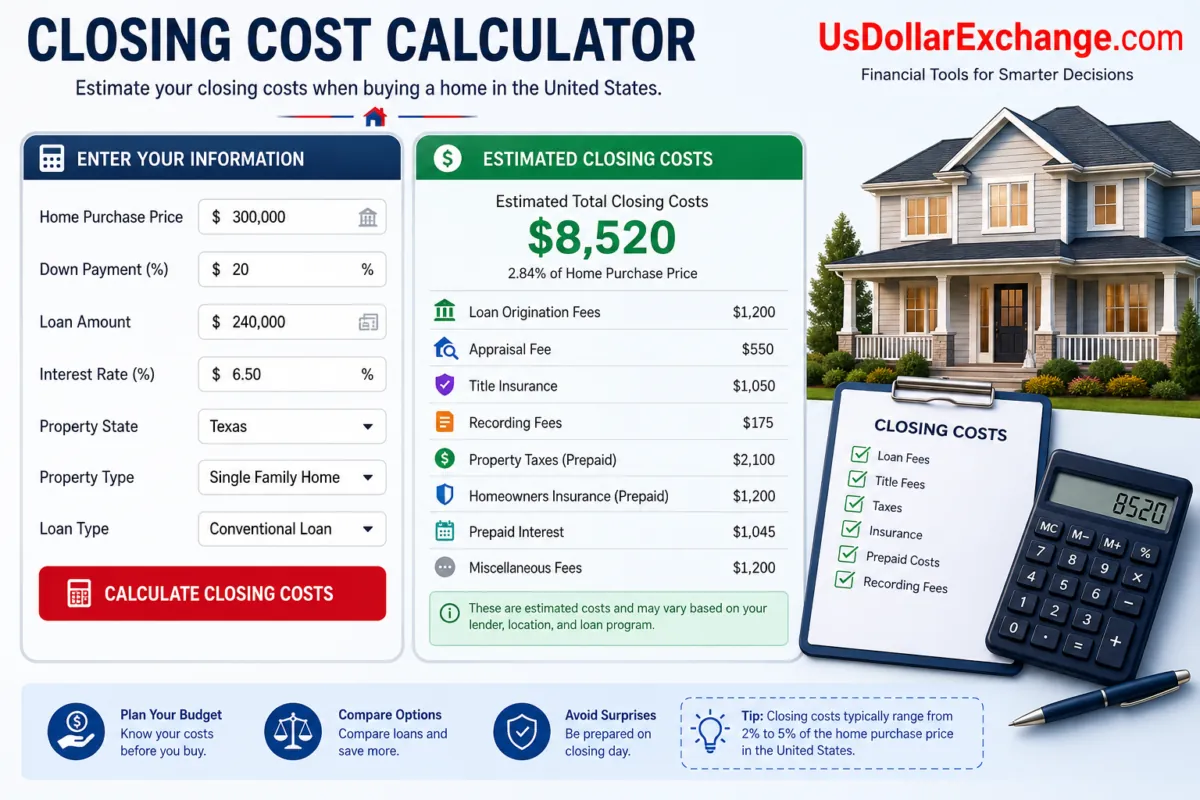
A Closing Cost Calculator helps you estimate these additional expenses before you commit to buying a property. Instead of guessing how much money you will need at the closing table, you can enter your expected home price, down payment, loan details, and location to develop a more realistic budget.
Closing Cost Calculator
cost is:
Closing costs would be 2.4% of your purchase price. Get a more accurate closing cost estimate by adjusting fees to fit your situation.
Buying a home involves more than saving for a down payment. Before you receive the keys, you may need to pay lender fees, appraisal charges, title services, property taxes, insurance premiums, and other expenses associated with completing the purchase. These costs can add up quickly, especially when you are already managing a mortgage payment and moving expenses.
For homebuyers across the United States, planning ahead can make the difference between a comfortable purchase and an unexpected financial burden. UsDollarExchange provides financial information and practical calculation resources to help readers make more informed money decisions.
Whether you are purchasing your first house in Oregon, moving to Texas, or buying a property in Florida, understanding closing expenses is an important step toward preparing for homeownership.
1. What Is Closing Cost Calculator?
A closing cost calculator is a financial tool that estimates the expenses involved in finalizing a real estate transaction. It helps buyers understand how much money they may need beyond their down payment.
The calculation typically considers the purchase price, mortgage amount, estimated lender charges, title-related fees, government recording charges, prepaid insurance, property taxes, and other applicable expenses.
For example, imagine you are buying a house for $350,000. Your lender estimates that the transaction will involve $9,000 in closing costs. A calculator can help you account for that amount when preparing your purchase budget.
However, the result is an estimate rather than a final bill. Actual expenses depend on your mortgage provider, property location, loan type, purchase agreement, and closing date.
UsDollarExchange encourages buyers to use estimates as a starting point and request a detailed Loan Estimate from their mortgage lender before making final financial decisions.
2. Estimated Closing Costs for Buyers
Estimated closing costs vary according to the property, financing arrangement, and services required to complete the transaction.
For many U.S. home purchases, buyers commonly budget approximately 2% to 5% of the purchase price for closing costs. This is a general planning range, not a guaranteed amount or a universal rule. Some transactions fall outside it.
Consider these examples:
| Home Purchase Price | Estimated Costs at 2% | Estimated Costs at 3% | Estimated Costs at 5% |
|---|---|---|---|
| $200,000 | $4,000 | $6,000 | $10,000 |
| $300,000 | $6,000 | $9,000 | $15,000 |
| $350,000 | $7,000 | $10,500 | $17,500 |
| $450,000 | $9,000 | $13,500 | $22,500 |
| $500,000 | $10,000 | $15,000 | $25,000 |
These figures are illustrative calculations based on the stated percentages. They are not quotes for actual properties.
Firstly, identify the price of the home you intend to purchase. Secondly, choose a reasonable planning percentage. After that, multiply the purchase price by the selected percentage.
For instance, a $350,000 property with estimated closing costs of 3% would produce a preliminary estimate of $10,500.
Nevertheless, your actual expenses could be lower or higher. A detailed estimate from your lender and settlement provider will provide a clearer picture.
3. Closing Cost
A closing cost is an expense associated with completing a property purchase and establishing the mortgage. These charges are separate from the money you contribute toward the home’s purchase price.
Some expenses compensate professionals who help process the transaction. Others cover services that protect the lender, verify property details, or establish ownership records.
Common charges include:
- Loan origination fees: Charges associated with processing and arranging your mortgage.
- Appraisal fees: Payment for an assessment of the property’s market value.
- Credit report fees: Charges for obtaining credit information used during mortgage underwriting.
- Title services: Costs associated with examining ownership records and completing title-related work.
- Recording fees: Government charges for officially recording relevant property documents.
- Prepaid homeowners insurance: Insurance premiums collected in advance when required.
- Property tax adjustments: Amounts allocated between the buyer and seller according to the transaction and local requirements.
- Mortgage-related insurance: Certain loans may require an initial insurance payment or escrow funding.
Not every buyer pays every charge. For example, some lenders offer credits that reduce upfront expenses in exchange for other loan terms, potentially including a higher interest rate.
Consequently, examine each line of your estimate rather than assuming that every mortgage comes with identical fees.
4. Closing Fee Calculator
A closing fee calculator helps you estimate the individual charges involved in completing your home purchase.
Although people sometimes use this phrase interchangeably with a closing cost calculator, a fee-focused calculation can be especially useful when you want to understand where your money will go.
Suppose your estimated transaction includes the following charges:
| Fee Category | Example Amount |
|---|---|
| Loan origination | $1,200 |
| Property appraisal | $600 |
| Credit and processing charges | $250 |
| Title and settlement services | $1,500 |
| Government recording charges | $200 |
| Other transaction fees | $750 |
| Total listed fees | $4,500 |
These amounts are hypothetical and do not represent current market quotations.
In this example, the listed fees total $4,500. However, the buyer’s complete closing costs could be higher because the table excludes possible prepaid insurance, property taxes, escrow deposits, and other expenses.
Therefore, use the fee calculator to understand the individual charges, then compare the result with your lender’s full estimate.
For additional financial planning, explore the Mortgage Payment Calculator, Home Affordability Calculator, and Down Payment Calculator on UsDollarExchange when these tools are available on the website.
5. Closing Costs Calculator
A closing costs calculator combines the estimated expenses into one figure, helping you understand how much cash you may need to complete a purchase.
A useful calculator should consider several details:
- The home’s purchase price.
- Your planned down payment.
- The estimated mortgage amount.
- Lender and appraisal fees.
- Title and settlement expenses.
- Prepaid taxes and insurance.
- Expected seller contributions or lender credits.
- Other charges relevant to the property and loan.
The mortgage amount matters because some charges are calculated using the loan balance rather than the home’s full price.
For example, assume you purchase a home for $400,000 and make a down payment of $80,000. Your planned mortgage would be $320,000 before accounting for any financed charges or adjustments.
If your preliminary closing cost estimate is $12,000, your estimated upfront contribution would be:
$80,000 + $12,000 = $92,000.
This calculation excludes other potential upfront expenses, such as moving costs, furniture, utility deposits, and any earnest money already paid.
Importantly, earnest money is generally credited toward the transaction according to the purchase agreement. It should not automatically be treated as an additional expense on top of every other amount.
6. How to Use a Closing Cost Calculator
Using a closing cost calculator is straightforward when you have a reasonable estimate of the home’s price and financing arrangements.
Step 1: Enter the purchase price.
Start with the expected price of the property. If you are comparing several homes, calculate each purchase separately.
Step 2: Add your down payment.
Enter the amount you plan to pay upfront toward the purchase price. The remaining amount will generally form the basis of your mortgage, subject to the loan terms.
Step 3: Enter your location.
Select the relevant state, county, or city when the calculator provides those options. Property taxes, recording fees, and certain settlement expenses differ by location.
Step 4: Include your estimated mortgage fees.
Use information from your lender when available. If you have not received a formal estimate, use clearly identified assumptions rather than treating guesses as confirmed charges.
Step 5: Account for prepaid expenses.
Include estimated homeowners insurance, property taxes, and escrow funding when applicable. Subsequently, check whether any of these amounts have already been included elsewhere in the calculation.
Step 6: Add credits and seller contributions.
If the seller has agreed to contribute toward eligible closing expenses, include the amount according to the purchase agreement and applicable loan rules.
Step 7: Review the result.
Compare the estimated total with your available savings. Finally, discuss significant differences with your lender or settlement agent before committing to the purchase.
A calculator makes budgeting easier, but it cannot replace the documents prepared for your specific transaction.
7. Typical Closing Cost
Typical closing costs include several categories rather than one fixed charge.
Lender charges cover services involved in evaluating and arranging the mortgage. Depending on the loan, these may include origination, underwriting, processing, and discount points.
Property-related services may include an appraisal, inspection, survey, or other assessments. Not all these services are necessarily classified as closing costs in every estimate, and some may be paid before closing.
Title and settlement expenses cover applicable services involved in reviewing ownership records, preparing documents, and completing the transfer.
Government charges can include document recording fees and applicable transfer taxes. The rules differ among states and local jurisdictions.
Prepaid expenses and escrow deposits may cover homeowners insurance, property taxes, and other amounts collected at closing to fund upcoming bills.
For example, a buyer in Oregon may encounter a different combination of charges from someone purchasing a home in Texas or New York. The difference may reflect local requirements, service providers, and the terms of the transaction.
Additionally, your mortgage type can influence which fees apply. Buyers using conventional loans, FHA loans, VA loans, or other financing arrangements should review the charges relevant to their specific loan.
UsDollarExchange recommends checking every item individually because two homes with the same purchase price can have different closing expenses.
8. How Much Are Closing Costs?
The amount depends on the home price, financing, location, and transaction details.
As an illustration, consider a buyer purchasing a $300,000 house. If the estimated closing costs equal 3% of the purchase price, the calculation is:
$300,000 × 0.03 = $9,000.
Now suppose another buyer purchases a $450,000 property and uses the same illustrative percentage.
$450,000 × 0.03 = $13,500.
The second buyer’s estimated expenses are $4,500 higher because the purchase price is larger.
However, applying the same percentage to every property is only a budgeting shortcut. Certain charges are fixed, others depend on the loan amount, and some are influenced by local taxes or the length of time between closing and the next payment date.
To improve your estimate, obtain a Loan Estimate from your lender after applying for a mortgage. Compare its figures with the final Closing Disclosure provided before closing.
If you are still exploring properties, calculate several price scenarios. This approach helps you understand whether a more expensive house would leave enough money for emergencies and other ownership expenses.
9. Who Pays Closing Costs?
Both buyers and sellers may pay closing costs, depending on the transaction, state requirements, and purchase agreement.
Buyers commonly pay certain mortgage-related charges, appraisal expenses, title services where allocated to them, prepaid insurance, and their share of applicable taxes or settlement expenses.
Sellers may pay real estate agent compensation according to their agreements, certain title or transfer charges, outstanding property obligations, and other expenses assigned to them under the contract.
These arrangements are not universal. Local customs and the terms negotiated by the parties can change who pays particular fees.
A seller may also agree to contribute toward a buyer’s eligible closing expenses. Such contributions are often called seller concessions or seller credits. However, mortgage programs may impose limits, and the contribution must be structured according to applicable rules.
For instance, imagine your estimated closing expenses are $11,000 and the seller agrees to contribute $4,000 toward eligible costs. If the entire contribution can be applied, your remaining closing expenses would be:
$11,000 − $4,000 = $7,000.
The actual amount due may differ because the contribution must follow the purchase contract and lender requirements.
Before signing an agreement, clarify which party is responsible for each charge. Doing so can prevent misunderstandings when the final settlement figures arrive.
10. Closing Costs vs. Down Payment
Closing costs and a down payment serve different purposes, even though buyers generally need to budget for both.
Your down payment is the portion of the purchase price you pay directly rather than borrowing through the mortgage.
Closing costs, by contrast, cover eligible expenses associated with arranging the financing and completing the property transaction.
Consider a $350,000 home purchased with a 10% down payment.
Also check our DOWN PAYMENT CALCULATOR
| Item | Calculation | Amount |
|---|---|---|
| Purchase price | — | $350,000 |
| Down payment | $350,000 × 10% | $35,000 |
| Estimated closing costs | $350,000 × 3% | $10,500 |
| Estimated upfront total | $35,000 + $10,500 | $45,500 |
This example assumes the buyer pays all $10,500 in estimated closing costs without credits. Actual charges will depend on the transaction.
Notice that the down payment reduces the amount borrowed, while closing costs pay for transaction-related expenses and other amounts due at settlement.
Furthermore, a down payment is not necessarily the only money you need before closing. Earnest money, inspections, moving expenses, and other costs may require cash earlier in the process.
For a more complete budget, combine your closing cost estimate with a Mortgage Calculator, Monthly Housing Cost Calculator, and Home Loan Calculator
11. Why Use a Closing Cost Calculator?
A closing cost calculator helps you make financial decisions before you become legally committed to a property purchase.
One major advantage is improved budgeting. Instead of focusing exclusively on the advertised price, you can estimate the additional cash required to complete the transaction.
It also helps you compare properties. For example, a lower-priced home with higher taxes or certain transaction charges might require a different upfront budget from a slightly more expensive property.
Another benefit is better preparation for discussions with lenders. When you understand the main expense categories, you can ask informed questions about origination fees, discount points, title charges, prepaid expenses, and available credits.
The calculator can also help you assess your savings. If a purchase would use nearly all your available cash, you may need to reconsider the timing, property price, or financing arrangements.
Moreover, estimates make it easier to compare different mortgage offers. A loan with lower upfront charges may have a higher interest rate, so evaluating the total cost over time is important.
UsDollarExchange aims to help readers approach financial decisions with clearer calculations rather than assumptions. Still, a calculator provides only a planning estimate; the lender’s documents and transaction-specific figures should guide your final budget.
12. Closing Cost Calculator Example
Let’s work through a complete example using an imaginary home purchase in the United States.
Assume the following details:
- Purchase price: $380,000
- Down payment: $76,000
- Estimated closing costs: 3% of the purchase price
- Seller contribution: $2,000 toward eligible expenses
- Other upfront costs: Not included
First, calculate the mortgage amount.
$380,000 − $76,000 = $304,000.
The estimated mortgage amount is $304,000, assuming the remaining purchase price is financed without additional adjustments.
Next, calculate the closing costs.
$380,000 × 0.03 = $11,400.
The estimated closing costs are $11,400.
Then, subtract the seller contribution.
$11,400 − $2,000 = $9,400.
The estimated closing expenses remaining after the assumed seller contribution are $9,400, provided the full credit is permitted and applied.
Finally, calculate the estimated upfront amount.
$76,000 + $9,400 = $85,400.
Therefore, this buyer would plan for approximately $85,400 toward the down payment and remaining closing costs combined.
This figure does not include moving expenses, repairs, furnishings, or other costs outside the calculation. It also assumes no earnest money has already been paid and credited toward the purchase.
The numbers are illustrative, not a quote for an actual mortgage or property.
Before completing a purchase, compare your calculations with your lender’s Loan Estimate and Closing Disclosure. These documents help you understand the actual charges and the amount you must bring to closing.
For more details information, check zillow closing cost calculator
13. FAQs
What is a closing cost calculator?
A closing cost calculator estimates the additional expenses involved in buying a home, including eligible lender fees, title services, recording charges, prepaid insurance, and property tax adjustments.
How much should I budget for closing costs?
A preliminary budget of approximately 2% to 5% of the purchase price is commonly used for planning. However, your actual expenses may fall outside that range depending on your loan, property, location, and transaction terms.
For more practical financial guidance, explore UsDollarExchange and its available resources on mortgage payments, currency conversion, budgeting, and other money-related calculations. A well-planned purchase begins with knowing not only what a home costs, but also how much cash you will need to make it yours.
Are closing costs included in the down payment?
No. The down payment contributes toward the purchase price, while closing costs cover expenses associated with completing the transaction. Buyers generally need to plan for both, although eligible credits or other arrangements may reduce their upfront contribution.
Can I negotiate closing costs?
Some charges and the allocation of certain expenses may be negotiable. You can ask your lender about available options and discuss eligible seller contributions with the other party. However, government fees and certain required charges may not be negotiable.
Can a seller pay my closing costs?
Yes, a seller may agree to contribute toward eligible buyer expenses. The amount permitted depends on the mortgage program, loan terms, property, and applicable rules. Any agreed contribution should appear in the transaction documents.
Do closing costs vary by state?
Yes. State and local taxes, recording requirements, title practices, and other transaction details can affect the amount. Buyers should obtain estimates that reflect the location of the property rather than relying exclusively on a national percentage.
Can closing costs be included in my mortgage?
Sometimes, depending on the loan structure and lender rules. Certain costs may be financed or offset through lender credits, but these arrangements can increase the loan balance or affect the interest rate. Not every expense can be included in the mortgage.
What is the difference between a Loan Estimate and a Closing Disclosure?
A Loan Estimate provides information about a mortgage’s expected terms, payments, and closing costs early in the application process. A Closing Disclosure presents the finalized transaction figures before closing. Review both documents and ask your lender about significant differences.
When should I calculate my closing costs?
Start when you begin comparing homes and update your estimate after receiving mortgage information. Review the figures again when your lender provides the relevant closing documents.
Is an online closing cost calculator accurate?
It can provide a useful estimate when you enter realistic information. However, its accuracy depends on the inputs and the costs it includes. A general calculator cannot guarantee the final amount for a specific property purchase.
What other financial calculators should homebuyers use?
Consider using a mortgage payment calculator, down payment calculator, home affordability calculator, property tax calculator, and mortgage refinance calculator. Together, these tools can help you evaluate both upfront expenses and ongoing housing costs.
Plan Your Home Purchase With Confidence
Buying a home requires more than choosing a property and arranging financing. You also need to understand the money due before ownership transfers and ensure you have enough savings to manage the transition.
A Closing Cost Calculator gives you a practical starting point. By estimating transaction fees, prepaid expenses, and potential seller contributions, you can prepare a more realistic upfront budget.
Nevertheless, do not treat an online estimate as a final settlement figure. Review your Loan Estimate, ask questions about unfamiliar charges, and check your Closing Disclosure before completing the transaction.
